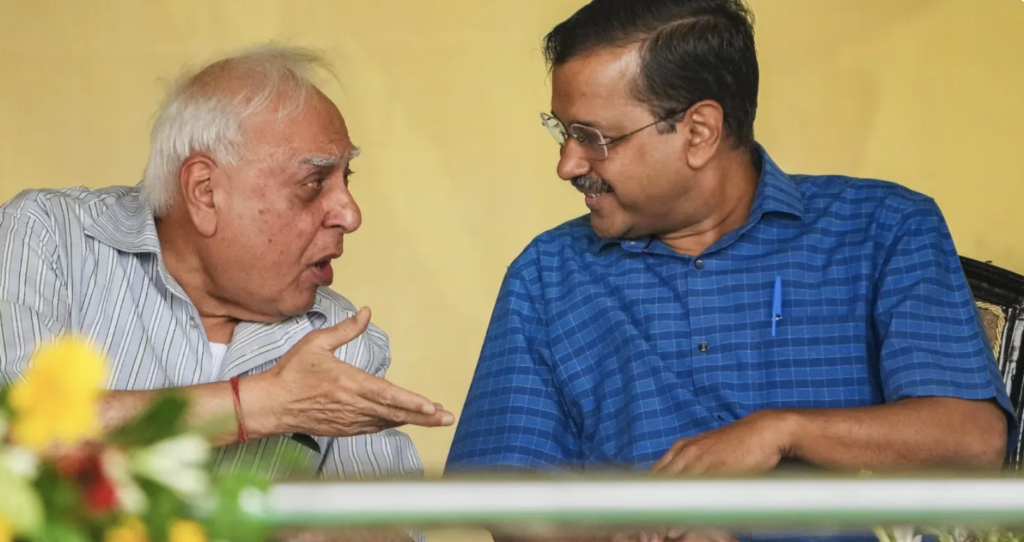
Kapil Sibal, Arvind Kejriwal, Retd. Justice A.S. Oka, Meenakshi Arora, Sanjay Hegade, Live Law, and The Hindu Named in Explosive Complaint Alleging Organised Legal- Media Conspiracy to Influence Pending Judicial Proceedings and Target Judges Delivering Adverse Orders Against the Ecosystem
Complaint Seeks Criminal Prosecution, Contempt Action, Cancellation of Licence to Practice, and Withdrawal of Senior Advocate Designation Against Kapil Sibal, Meenakshi Arora, Sanjay Hegde, Vivek Tankha, Kaleeswaram Raj, Live Law, and The Hindu — Accused of Acting as Co-Conspirators in an Alleged Coordinated Campaign of Judicial Interference, Narrative Manipulation, and Public Pressure on Constitutional Courts.
Prosecution has been sought against the accused persons under Sections 192, 193, 120-B, 107, 109, 34 and other applicable provisions of the Indian Penal Code (and corresponding provisions of the Bharatiya Nyaya Sanhita), along with initiation of criminal and civil contempt proceedings under Sections 2(b), 2(c), 12 read with Section 15 of the Contempt of Courts Act, 1971. The offences alleged in the complaint carry punishment extending up to seven years’ imprisonment, apart from fine, contempt consequences, professional disciplinary action, cancellation of licence to practice, and withdrawal of Senior Advocate designation.
This complaint has been filed by the Indian Lawyers and Human Rights Activists Association.
Publication of Distorted, One-Sided, False, and Misleading Narratives Through Suppression of Crucial Material Facts, Selective Presentation, Twisting of Records, and Intellectual Dishonesty Allegedly Exposed Through Detailed Documentary Proofs and Chronological Evidence
A major constitutional complaint filed before the Hon’ble President of India has levelled serious allegations against several prominent political leaders, Senior Advocates, retired judicial personalities, digital legal portals, and media organisations, alleging that a carefully coordinated campaign of distorted, selective, and misleading publications was undertaken to influence pending judicial proceedings and target constitutional courts and judges passing adverse orders.
The complaint claims that the entire controversy surrounding the recusal issue before the Hon’ble Delhi High Court was deliberately projected before the public through selective suppression of material facts, one-sided legal commentary, strategic omission of binding judicial precedents, and carefully synchronised digital amplification intended to create a false public perception regarding the impartiality and integrity of Hon’ble Ms. Justice Swarana Kanta Sharma.
According to the complaint, the most striking feature of the alleged campaign is not merely criticism of a judicial order, but the “systematic suppression of crucial material facts which completely destroy the narrative publicly projected by the accused persons.”
The complaint alleges that several publications, interviews, podcasts, editorials, YouTube discussions, and digital broadcasts repeatedly portrayed attendance at programmes organised by Akhil Bharatiya Adhivakta Parishad (ABAP) as a supposed indicator of ideological bias or lack of judicial independence. However, according to the complainant, the same persons deliberately concealed from the public that several judges who had reportedly attended programmes organised by the same organisation had earlier heard matters concerning Shri Arvind Kejriwal himself and had even granted reliefs including bail orders.
The complaint states that this single suppressed fact completely demolishes the central narrative sought to be projected against Hon’ble Ms. Justice Swarana Kanta Sharma.
According to the complaint, if attendance at such programmes genuinely created reasonable apprehension of bias, then identical objections ought to have been consistently raised against all similarly situated judges. However, no such objections were ever raised when judicial orders were favourable to Shri Arvind Kejriwal or aligned with the interests of the alleged “ecosystem.”
The complaint therefore alleges that the recusal controversy was not driven by genuine concern regarding judicial ethics but was “selectively weaponised” only after an adverse judicial order came to be passed.
The complaint further alleges that there was deliberate intellectual dishonesty in suppressing the controversial judgment in In Re Vijay Kurle, In re, (2021) 13 SCC 616, where the Supreme Court had observed that father and son are “different entities” while rejecting allegations of conflict of interest involving Justice R.F. Nariman and Senior Advocate Fali S. Nariman.
According to the complaint, despite now aggressively invoking theories of “perceived bias” and “institutional conflict” against Hon’ble Ms. Justice Swarana Kanta Sharma, the present accused persons never criticised or questioned the Vijay Kurle ruling or the judges involved therein. The complaint argues that this selective silence exposes “double standards, selective morality, and politically convenient recusal theory.”
The complaint further alleges that several publications intentionally omitted discussion of subsequent judicial developments and binding constitutional principles concerning nemo judex in causa sua — the doctrine that no person should be a judge in his own cause — while simultaneously presenting highly selective commentary before the public.
The complaint repeatedly accuses certain legal-media platforms of “twisting facts, selectively extracting portions of proceedings, suppressing material context, and presenting ideologically filtered narratives disguised as objective legal journalism.”
One of the most serious allegations concerns the publication by Live Law on 15.04.2026 of an article titled:
“Wouldn’t Have Attended Adhivakta Parishad’s Program As A Sitting Judge As It’s Politically Inclined : Justice A.S. Oka”
The complaint points out that this publication appeared just five days before the Hon’ble Delhi High Court delivered its detailed judgment dismissing Shri Arvind Kejriwal’s recusal plea on 20.04.2026.
According to the complaint, the timing of the article, combined with the broader pattern of editorials, interviews, YouTube broadcasts, and social media amplification, demonstrates a coordinated narrative-building exercise intended to shape public discourse before delivery of the judicial order.
The complaint further alleges that immediately after dismissal of the recusal plea, the campaign intensified through editorials, digital discussions, and public commentary allegedly aimed at portraying the concerned Judge as politically compromised.
The complaint states that the cumulative effect of these publications was to create an organised atmosphere of suspicion and hostility against the concerned Court and to send a larger institutional message to judges hearing politically sensitive matters:
“Pass favourable orders or face coordinated harassment, media attacks, and public defamation.”
The complaint also alleges that some digital legal platforms have repeatedly published one-sided and selective reporting against advocates, organisations, and individuals perceived to be ideologically opposed to influential legal circles. It claims that multiple legal notices, contempt proceedings, and damages actions have already been initiated or proposed against certain platforms for alleged biased and distorted reporting practices.
According to the complaint, the cumulative evidence — including publication timelines, coordinated narratives, selective suppression of facts, synchronised digital amplification, strategically timed interviews, and identical themes repeated across multiple platforms — allegedly reveals not isolated journalism or independent legal commentary, but a “structured legal-media operation designed to influence public perception regarding pending judicial proceedings and publicly delegitimise judges delivering orders adverse to the ecosystem.”
The complaint finally warns that if such methods are normalised, constitutional courts across India may increasingly face organised media pressure campaigns whenever politically powerful litigants receive unfavourable judicial orders, thereby seriously endangering judicial independence and public confidence in the justice delivery system.
You can add the following detailed points/headings in the news article based on the complaint. The complaint specifically alleges selective silence, intellectual dishonesty, suppression of material facts, coordinated timing of publications, and a larger legal-media ecosystem operating to influence public perception regarding pending judicial proceedings.
Key Explosive Allegations Emerging from the Complaint
1. “Selective Morality” and “Convenient Recusal Theory” Allegedly Exposed
The complaint alleges that the entire recusal controversy was built upon a selectively applied theory of “perceived bias” which was never invoked when judges allegedly associated with the same organisations passed favourable orders for Shri Arvind Kejriwal, including bail orders. According to the complaint, the same persons who now publicly attacked Hon’ble Ms. Justice Swarana Kanta Sharma never objected to hearings by similarly situated judges when judicial outcomes suited their interests.
2. Complaint Alleges Suppression of Material Facts and Intellectual Dishonesty
A major allegation in the complaint is that crucial facts were deliberately concealed from the public to sustain a politically convenient narrative. The complaint claims that several judges reportedly associated with Adhivakta Parishad had heard matters concerning Shri Arvind Kejriwal and even granted reliefs, yet no allegations of bias were raised against them. According to the complaint, suppression of these facts completely destroys the theory now projected against Hon’ble Ms. Justice Swarana Kanta Sharma.
3. Deepak Gupta–Rohinton Nariman Controversy Never Criticised by the Same “Ecosystem”
The complaint strongly points out with proofs that the very persons who aggressively targeted Justice Swarana Kanta Sharma maintained “complete, absolute, and deliberate silence” regarding the controversy involving Justice (Retd.) Rohinton Fali Nariman hearing matters connected with his father Shri Fali S. Nariman, Senior Advocate.
The complaint further alleges that the judgment in In Re Vijay Kurle, In re, (2021) 13 SCC 616 delivered by Justice (Retd.) Deepak Gupta and Justice (Retd.) Aniruddha Bose — holding that father and son are separate legal entities and that no conflict of interest existed — was never criticised by the same legal-media circles now invoking “perceived bias” against Justice Swarana Kanta Sharma and criticizing her judgment where there was no direct conflict of interest which is self explainatory.
According to the complaint, this selective silence conclusively exposes “double standards, mala fide intention, and ecosystem-based targeting of judges delivering unfavourable orders.”
4. Complaint Alleges Justice (Retd.) Deepak Gupta’s Ruling Was “Per Incuriam”
The complaint further claims that the ruling in Vijay Kurle was per incuriam and vitiated stood contrary to binding constitutional principles governing nemo judex in causa sua and constitution bench judgemnets and later stood impliedly overruled by the three-judge bench decision in Krishnadatt Awasthy v. State of M.P..
According to the complaint, despite the alleged gravity of those issues, no media campaign, editorial attack, digital mobilisation, or public pressure campaign was launched against Justice (Retd.) Rohinton Nariman, Justice (Retd.) Deepak Gupta, or Justice Aniruddha Bose.
5. Kapil Sibal Channel and Retired Judges — Complaint Alleges Networked Coordination
The complaint alleges that Justice (Retd.) Abhay S. Oka, Justice (Retd.) Deepak Gupta had appeared on the YouTube platform “#DilSeWithKapilSibal,” which later became one of the primary platforms used for the impugned discussions regarding the Delhi High Court recusal controversy. According to the complaint, this demonstrates “personal proximity, ideological alignment, and networked coordination” among several accused persons.
6. Live Law Accused of Running Pattern of One-Sided and Selective Reporting
The complaint contains detailed allegations against Live Law, claiming that it repeatedly published selective, incomplete, distorted, and ideologically filtered versions of court proceedings. The complaint further alleges that Live Law has previously faced legal notices, contempt proceedings, and damages actions for alleged one-sided and misleading reporting.
According to the complaint, the publication by Live Law on 15.04.2026 of Justice (Retd.) Oka’s statement concerning Adhivakta Parishad — merely five days before the Delhi High Court’s recusal judgment — was a “strategically timed intervention” intended to influence public discourse regarding the pending proceedings.
7. “Sequential Multi-Platform Narrative Building” Alleged
The complaint maps what it calls a “precisely coordinated amplification chain” involving:
· Live Law publication dated 15.04.2026,
· Shri Arvind Kejriwal’s public letter dated 27.04.2026,
· The Hindu editorial dated 29.04.2026, and
· Kapil Sibal’s YouTube programme dated 02.05.2026.
According to the complaint, these publications formed a synchronised narrative-building operation aimed at delegitimising the Delhi High Court after rejection of the recusal application.
8. Complaint Claims the Campaign Was Intended to Send a Message to Judges Across India
One of the strongest allegations in the complaint is that the campaign was intended not merely to attack one judge, but to send a broader institutional warning:
Judges delivering adverse orders against politically influential persons or the “ecosystem” may face coordinated media attacks, public pressure campaigns, and organised digital defamation.
The complaint describes this as a direct threat to judicial independence and constitutional governance.
9. Complaint Relies Upon Supreme Court Judgments Against Advocates and Senior Counsel
The complaint heavily relies upon judgments including:
· R.K. Anand v. Registrar, Delhi High Court
· R. Muthukrishnan v. Registrar General, High Court of Madras
· Yatin Narendra Oza v. Suo Motu High Court of Gujarat
·
The complaint argues that Senior Advocates enjoy no immunity where their conduct allegedly undermines judicial independence or administration of justice.
THE LAW IS SETTLED: CO-CONSPIRATORS WHO SPREAD FALSE NARRATIVES TO FACILITATE OR COVER UP A CRIME FACE IDENTICAL PUNISHMENT AS THE MAIN ACCUSED
The legal position governing the criminal liability of all persons — advocates, media organisations, digital platforms, and public figures alike — who participate in, facilitate, amplify, or provide cover for a criminal conspiracy by spreading false narratives, distorted facts, and manufactured public opinion is not merely settled in India. It is settled by a long, consistent, and unbroken line of binding precedents of the Hon’ble Supreme Court of India and the constitutional High Courts, which together establish beyond all doubt that every person who knowingly joins a conspiracy — whether as its architect, its executor, or its amplifier — is liable to be visited with the same punishment as the principal offender, regardless of the precise role played by each conspirator in the common design.
The foundation of this principle is Section 120-B of the Indian Penal Code read with Sections 107 and 34 IPC, which together create a complete and interlocking framework of criminal liability: Section 120-B punishes the agreement itself; Section 107 punishes every form of abetment including instigation, conspiracy, and intentional aiding; and Section 34 makes every act done in furtherance of the common intention the joint and several act of every participant. To this framework, Section 10 of the Indian Evidence Act adds the critical evidentiary dimension — providing that once reasonable ground exists to believe that two or more persons have conspired together, anything said, done, or written by any one conspirator in furtherance of the common design is admissible as evidence against every other conspirator, even if made before one joined or after another departed the conspiracy. In the present case, the main and primary offences alleged against all accused are under Sections 192 and 193 of the IPC — the fabrication of false evidence and the fabrication of false evidence in judicial proceedings — by the deliberate creation, distortion, selective curation, and public projection of false, misleading, and manipulated narratives concerning proceedings pending before the Hon’ble Delhi High Court. Every advocate, every media organisation, every digital platform, and every public figure who knowingly participated in, amplified, or facilitated that fabrication and its dissemination is, in law, equally liable for those offences as the person who first conceived and created them.
The binding precedents establishing this settled legal position, which the appropriate authority in the present case is respectfully urged to take cognizance of, are as follows:
Shyni Varghese v. State (Govt. of NCT of Delhi), 2008 SCC OnLine Del 204, ;CBI v. Bhupendra Champaklal Dalal, 2019 SCC OnLine Bom 140, ; Raman Lal Vs. State of Rajasthan 2000 SCC OnLine Raj 226, ; Pratapbhai Hamirbhai Solanki v. State of Gujarat, (2013) 1 SCC 613, ; Bhupinder Singh Patel Vs CBI, 2008 SCC OnLine Del 711.
That in Shyni Varghese v. State (Govt. of NCT of Delhi), 2008 SCC OnLine Del 204, the Hon’ble Delhi High Court recognised that participation in press conferences and dissemination of false or misleading facts to the media may itself constitute a relevant circumstance indicating involvement in a criminal conspiracy aimed at concealing the offence and screening the offenders.
That the Hon’ble Bombay High Court in CBI v. Bhupendra Champaklal Dalal, 2019 SCC OnLine Bom 140, elaborately considered the law relating to criminal conspiracy and applicability of Section 10 of the Indian Evidence Act in the light of binding Supreme Court precedents. he Hon’ble Court further explained the wide scope of Section 10 of the Evidence Act and held that anything said, done, or written by a co-conspirator in reference to the common intention becomes relevant against the other conspirators, even if made before one conspirator joined or after another left the conspiracy. The Hon’ble Court reiterated that conspiracy is generally conceived and executed in secrecy and privacy, and therefore direct evidence of conspiracy is seldom available. Consequently, the offence of criminal conspiracy can be proved through circumstantial evidence, conduct of parties, surrounding circumstances, and necessary inferences drawn from cumulative facts. The Hon’ble Court observed that the cumulative effect of all proved circumstances has to be considered rather than examining each circumstance in isolation.That in Raman Lal Vs. State of Rajasthan 2000 SCC OnLine Raj 226, it is ruled as under;
“Conspiracy – I.P.C. Sec. 120 (B) – Apex court made it clear that an inference of conspiracy has to be drawn on the basis of circumstantial evidence only because it becomes difficult to get direct evidence on such issue – The offence can only be proved largely from the inference drawn from acts or illegal omission committed by them in furtherance of a common design – Once such a conspiracy is proved, act of one conspirator becomes the act of the others – A Co-conspirator who joins subsequently and commits overt acts in furtherance of the conspiracy must also be held liable”
The complaint additionally asserts that the impugned acts also prima facie constitute criminal contempt under Sections 2(c) and 12 of the Contempt of Courts Act, 1971, inasmuch as the alleged publications and coordinated digital campaigns were capable of interfering with due administration of justice, prejudicing pending judicial proceedings, scandalising constitutional courts, and lowering public confidence in judicial independence. Reliance is specifically placed upon Nilesh Navalakha v. Union of India, 2021 SCC OnLine Bom 56, wherein the Hon’ble Bombay High Court summarised the binding legal principles governing responsible reporting of sub judice matters and reiterated that publication of distorted, selective, misleading, or prejudicial material concerning pending judicial proceedings may amount to interference with administration of justice and criminal contempt of court. Non following the said directions also makes the accused liable for punishment under civil contempt as per sec 2(b),12 of the Contempt of Courts Act,1971.