Victory of the Constitution, Historic Change in the Justice System – National Judicial Policy Checklist Based on Supreme Court Orders Released
Ordinary citizens will get justice, corrupt officials will go to jail
End of arbitrariness in justice — accountability established from bureaucracy to judiciary
A binding law ensuring legal procedure from departmental action, suspension, or dismissal to criminal prosecution.
The Indian Bar Association has released a checklist based on Supreme Court orders for every case.
The greatest benefit will go to ordinary citizens and junior lawyers, as it will now be mandatory to provide equal justice to all in every case according to law.
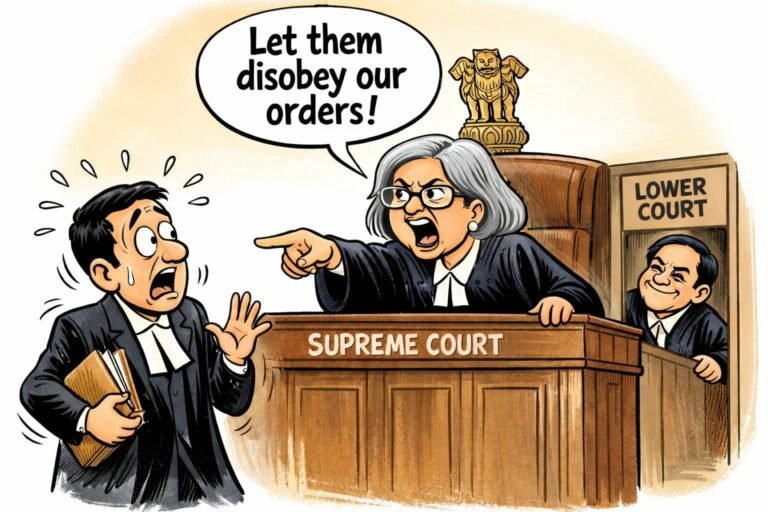
Additionally, provisions have been made to take action against all officials who fail to comply with the law — including judges — and a detailed checklist has been prepared to ensure strict adherence to the binding orders of the Supreme Court. This will ensure transparency and accountability in every judicial process.
Under the Indian Constitution and the law established by the Supreme Court, all public authorities, police officers, and courts have a duty to apply the proper and established law suo motu and ensure its benefit reaches ordinary citizens. If a person is unaware of the law, it is the responsibility of public servants, police officers, government advocates, and judges to protect their rights, so that no citizen’s constitutional or legal rights are violated.
New Delhi: The Indian Bar Association (IBA) has released an “Integrated Judicial Checklist” based on the binding orders of the Supreme Court and the principles of the Indian Constitution. This is being seen as a historic step toward ensuring transparency, equality, and accountability in the justice system.
The checklist ensures that if a person obtains a judicial declaration in their favor against the state or any other party in a case, the same benefit must be automatically (suo motu) extended to all citizens in similar circumstances, thereby avoiding repetitive litigation. This not only ensures equality before the law, but also reduces unnecessary burden on courts and litigants. The greatest benefit of this initiative will go to junior lawyers and ordinary citizens, as it now makes it mandatory to provide equal justice to all in every case according to law.
Under the Indian Constitution and the law established by the Supreme Court, all public authorities, police officers, and courts have a duty to implement proper and established law suo motu.
Ignorance of the law is no excuse. Every officer and judge is obliged to verify that the order they pass does not violate the binding law established by the Supreme Court.
Strict Consequences for Non-Compliance with the Law
According to the checklist, violating the orders of the Supreme Court will attract the following strict consequences—
- Contempt of Court: Under Sections 2(b) and 12 of the Contempt of Courts Act, 1971
- Criminal Liability: Under Sections 198, 201, 255, 257, 258, etc., of the Bharatiya Nyaya Sanhita (BNS) (corresponding to Sections 166, 167, 217, 219, 220 of the former IPC)
- Departmental Action: Suspension, demotion, or dismissal from service
Key Objectives of the Checklist:
- Protection of Fundamental Rights: Now, no citizen’s rights can be violated, even inadvertently.
- Curb on Corruption: Strict action will be ensured against arbitrary or unjust decisions by government officials and courts.
- Incorporation of Accountability in Law: Officials and judges can exercise their powers only in accordance with the Constitution and the orders of the Supreme Court.
- Guarantee of Equal Justice: All persons in similar circumstances will receive the benefit of decisions, eliminating the need for repetitive litigation.
The Indian Bar Association states that this integrated judicial checklist will not only bring justice to the doorstep of the common citizen but will also strengthen accountability, transparency, and procedural discipline within the judiciary and all public authorities.
The checklist contains a comprehensive and systematic compilation of nearly 200 Supreme Court orders, guidelines, and binding legal provisions, compliance with which is mandatory in every case. This checklist is not merely a theoretical document; it has been prepared as a practical guide. It clearly underscores how a citizen or advocate must be treated fairly, impartially, equally, and legally when approaching any government official, police officer, or court.
The fundamental objective of this checklist is to ensure that innocent individuals are not harassed at any level, are not trapped in false cases, and if a crime is proven, effective, impartial, and lawful action is taken against the offenders without delay. The checklist clearly outlines the constitutional and statutory standards to be followed at every stage—investigation, arrest, prosecution, hearing, and judgment.
This checklist has been prepared with the purpose of ensuring that in all types of proceedings, including civil and criminal cases, all relevant stakeholders discharge their legal duties properly and in accordance with the law. It constitutes a comprehensive and systematic compilation of the Supreme Court’s binding orders, guiding principles, and legal provisions that apply to all public officials, tribunals, commissions, public servants, advocates, police officers, ministers, and judges, and compliance with these provisions is mandatory at every level.
The checklist also explicitly details that any negligence, arbitrariness, malicious intent, or violation of the law in duty performance can attract legal action against the responsible parties, including advocates, government lawyers, senior lawyers, police officers, ministers, tehsildars, district officers, and even judges. These provisions are arranged systematically so that an affected citizen can clearly understand at which stage, against which officer, and under which law action is possible.
Most importantly, the checklist ensures that not only the officials who directly commit a wrongdoing but also those who obstruct legal action, hinder investigations, or attempt to shield culpable officers will be equally liable to punishment. Therefore, this checklist serves not only as a powerful tool against crime and corruption but also as a means to institutionally enforce accountability, transparency, and procedural discipline within the judicial system.
The concept of this checklist and legal handbook is inspired by the “National Judicial Policy” proposed by the Hon’ble Chief Justice of India, Shri Suryakant. The Hon’ble CJI had expressed serious concern over the fact that despite identical facts and identical laws, different courts across the country were issuing contradictory orders, thereby undermining the principle of equal justice and resulting in injustice to ordinary citizens. He emphasized the need to ensure uniformity, predictability, and legal certainty within the judicial system so that every person receives equal justice in similar circumstances.
In this context, during correspondence with Advocate Shivam Gupta of the Junior Advocates and Law Students Association of India, the Hon’ble Chief Justice of India, Shri Suryakant, expressed the expectation of cooperation and constructive initiative in this direction. Based on the guidance and inspiration derived from that dialogue, the Junior Advocates and Law Students Association, under the guidance of the National President of the Indian Bar Association, Advocate Nilesh Ojha, initiated the preparation of this legal checklist and handbook.
This handbook is not merely the effort of a single individual or institution, but the result of collective legal consciousness. Its creation has benefited from the valuable contributions of senior and junior advocates, judicial officers, law students, human rights activists, advocates of women’s, men’s, and children’s rights, representatives of social organizations, as well as spiritual and ethical thinkers. Each contributor, based on their experience, study, and practical understanding, has worked to make the justice system more human-centric, fact-based, and accountable.
This initiative lays the foundation for a new chapter in India’s legal system—a chapter in which the law is not limited to books but becomes an effective instrument for delivering fair, impartial, and accessible justice in practice. The benefits of this checklist and handbook will extend not only to the current generation but to many generations to come, strengthening judicial transparency, accountability, and procedural values over time.
The initiative has received wide appreciation and recognition from various sections of society—the legal community, educators, civil society organizations, and the general public—which underscores the contemporary relevance and long-term significance of this effort.