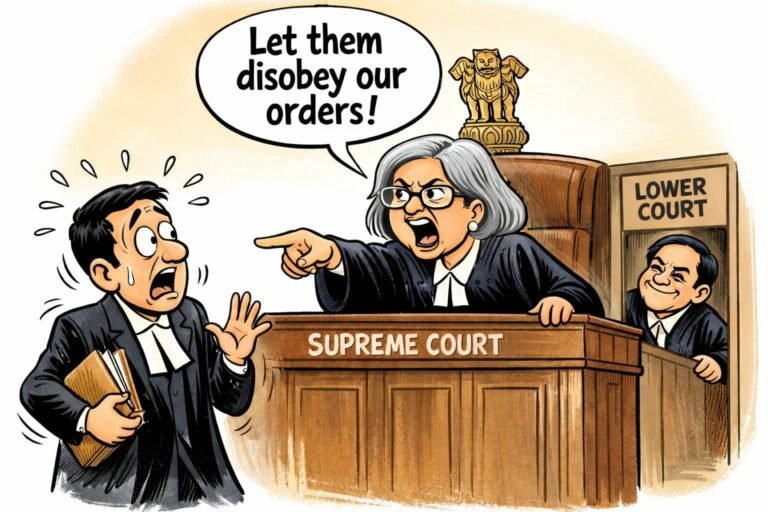
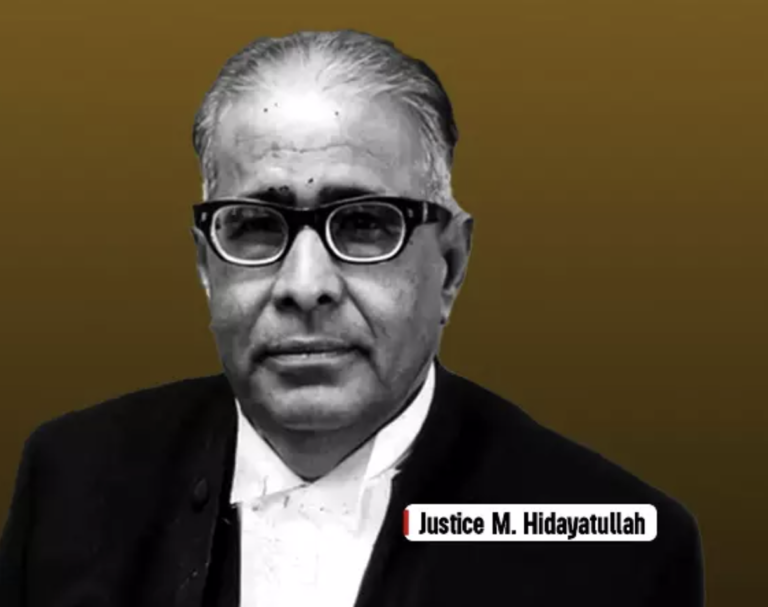
The Supreme Court rule permitting dismissal of a review petition without hearing and without recording reasons is unconstitutional, as it violates fundamental rights, denies fair procedure, and disregards the caution expressed by the Seven-Judge Constitution Bench.
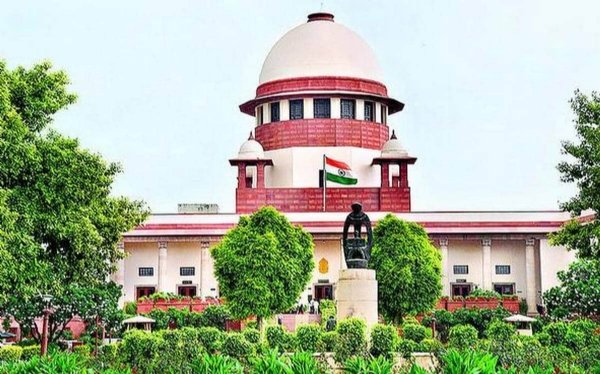
Various Bar Association wrote CJI to struck down Order XLVII Rule 3 of the Supreme Court Rules, 2013 .
Earlier, in Prem Chand Garg v. Excise Commissioner, U.P., AIR 1963 SC 996, a Constitution Bench struck down a similar Supreme Court rule, holding that the Court’s rule-making power is subordinate to the Constitution and cannot be exercised to curtail, restrict, or burden fundamental rights. Any procedural rule that abridges constitutional guarantees is ultra vires and void. Recently Supreme Court heard the petition and amended rules granting mandatory open court hearing of review in death penalty cases. [Mohd. Arif @ Ashfaq v. Supreme Court of India, 2014 (9) SCC 737]
The ratio in P.N. Eswara Iyer v. Registrar, Supreme Court of India, (1980) 4 SCC 680, though upholding rules permitting dismissal of review petitions without oral hearing, is rendered per incuriam to the extent it overlooks binding constitutional safeguards under Articles 14 and 21. In any event, the position no longer holds the field and stands impliedly overruled by subsequent larger Bench decisions, particularly the Nine-Judge Constitution Bench.
The judgment in P.N. Eswara Iyer v. Registrar, Supreme Court of India (1980) 4 SCC 680 , is per incuriam, being contrary to the earlier and binding Seven-Judge Constitution Bench decision in Maneka Gandhi v. Union of India, (1978) 1 SCC 248. In P.N. Eswara Iyer, a smaller Bench countenanced the routine in-chamber dismissal of review petitions without granting any hearing. This approach runs directly contrary to the authoritative ratio in Maneka Gandhi, which unequivocally constitutionalised procedural fairness and the audi alteram partem principle—no one should be condemned unheard—as an integral facet of Article 21 in the determination of rights.
The Seven-Judge Bench in Maneka Gandhi observed:
“The core of it must, however, remain, namely, that the person affected must have a reasonable opportunity of being heard and the hearing must be a genuine hearing and not an empty public relations exercise.”
It further recognised that, depending on the exigencies of the situation, natural justice may also be satisfied through a post-decisional remedial hearing, but the essential requirement of a real and reasonable opportunity to present one’s case cannot be extinguished as a matter of routine.
Reinforcing this minimum content of natural justice, the Constitution Bench relied upon Tucker, L.J. in Russell v. Duke of Norfolk [1949] 1 All ER 109, holding that:
“Whatever standard of natural justice is adopted; one essential is that the person concerned should have a reasonable opportunity of presenting his case.”
Therefore, to the extent P.N. Eswara Iyer is understood to permit routine in-chamber dismissal of review petitions without hearing—without demonstrating any compelling necessity or exceptional circumstances warranting exclusion of audi alteram partem—it is inconsistent with the binding ratio of the Seven-Judge Bench in Maneka Gandhi, and is thus per incuriam and non-binding.
The Seven-Judge Constitution Bench issued an unequivocal and emphatic warning that Parliament or the executive may, at times, frame laws or procedures that dispense with hearing, confer unilateral and unguided power upon authorities, and permit adverse action without affording the affected person any meaningful opportunity of defence. The Court cautioned that such callous disregard for procedural fairness poses a grave constitutional peril, for it enables the State to curtail life and personal liberty at will, thereby converting constitutional guarantees into empty formalities. Invoking Article 10 of the Universal Declaration of Human Rights—which mandates a fair and public hearing by an independent tribunal—the Bench underscored that these protections would be reduced to a mere verbal hollow if the protective armour of audi alteram partem were stripped away.
These observations constitute a powerful constitutional admonition against any procedure that authorises deprivation of life or personal liberty without a fair hearing. They must be read in the context of the Court’s transformative interpretation of Article 21, which requires that every procedure affecting liberty must incorporate at least the minimum safeguards of fairness, foremost among them the right to be heard. The Bench further warned that if departures from natural justice are normalised under the guise of convenience, urgency, or administrative efficiency, authorities will inevitably resort to them with increasing frequency, resulting in a steady and irreversible erosion of individual freedoms.
Accordingly, any rule that excludes hearing as a matter of routine— not only rests on constitutionally suspect foundations but also stands in direct defiance of the explicit caution administered by the Seven-Judge Bench. Such a rule cannot claim constitutional legitimacy, for it undermines the very essence of due process, nullifies the guarantee of fair procedure under Article 21, and disregards binding constitutional doctrine.
Moreover, the judgment does not lay down an absolute bar on oral hearing. Properly construed, it preserves the principles of procedural fairness and judicial discretion, thereby supporting the necessity of oral hearing where constitutional rights are implicated.
The foundational principle of natural justice that no person shall be condemned without being afforded a fair and reasonable opportunity of hearing—embodied in the maxim audi alteram partem—has been consistently recognized as an indispensable requirement of fairness in all judicial, quasi-judicial, and even administrative decision-making. This doctrine, which literally means “hear the other side,” ensures that no decision adversely affecting rights, liberty, reputation, or civil consequences can be taken behind the back of the affected party. The Supreme Court of India, through authoritative Constitution Bench jurisprudence, has elevated this principle from a mere procedural rule to a component of constitutional fairness under Articles 14 and 21. In A.K. Kraipak v. Union of India, the Court emphasized that the dividing line between administrative and quasi-judicial functions has become thin and that the aim of the rules of natural justice is to prevent miscarriage of justice; accordingly, even administrative actions affecting rights must conform to these principles.
The Indian Bar Association, Junior Advocates and Law Students Association of India, Indian Lawyers and Human Rights Activists Association, Supreme Court and High Court Litigants Association, Civil Rights Society, Sanwidhandharmee Movement, and Sanwidhan Raksha Samitee have addressed representations highlighting the gross illegality and continuing violation of constitutional rights arising from the impugned rule.
It has been specifically pointed out that the said rule is contrary not only to settled constitutional principles but also to the authoritative pronouncement of a Nine-Judge Constitution Bench of the Supreme Court, which has unequivocally laid down binding law under Article 141.
Notwithstanding the existence of such binding precedent, the continuation of the impugned rule amounts to a direct departure from constitutional mandates and judicial discipline, thereby rendering it unconstitutional, arbitrary, and liable to be struck down.
The activism of Bar started when recently, the above Bar Associations have strongly objected to the alleged unconstitutional conduct of Justice Vikram Nath and Justice Sandeep Mehta and have filed a petition before the National Human Rights Commission seeking an inquiry and appropriate action for serious violations of the fundamental rights of activists and advocates, including Senior Counsel Raju Ramachandran and seventeen advocates, among them women advocates belonging to Scheduled Caste and backward communities.
They have further sought the removal of Justice Vikram Nath from the post of NALSA, contending that any act of threatening advocates from accepting briefs amounts to a direct attack on the independence of the Bar. It has been asserted that the continuance of Justice Vikram Nath as head of a statutory body entrusted with providing and safeguarding legal aid to citizens would be inappropriate in light of the existence of video recordings allegedly evidencing intimidation and violation of the rights of advocates and women.
Following these developments, discussions have reportedly emerged within sections of the legal fraternity regarding future institutional appointments, including suggestions that, in place of Justice Vikram Nath, the name of Justice R. Banumathi may be considered for recommendation as the next Chief Justice of India. Further details in this regard are stated to be available at the referred link.
Background of Review Jurisdiction and Shift to Chamber Disposal
Article 137 of the Constitution of India confers upon the Supreme Court the power to review its own judgments and orders. It reads as under:
“137. Review of judgments or orders by the Supreme Court —
Subject to the provisions of any law made by Parliament or any rules made under Article 145, the Supreme Court shall have power to review any judgment pronounced or order made by it.”
The constitutional provision itself does not prescribe any restriction upon the manner of hearing of a review petition.
Historically, review petitions in the Supreme Court were heard in open court. However, around 1966, rules were framed providing for disposal of review petitions by circulation that was an amendment in Order XL, Rule 3 of the Supreme Court Rules, 1966 . These provisions were subsequently reaffirmed in later versions of the Supreme Court Rules.
Under Order XLVII Rule 3 of the Supreme Court Rules, 2013, it is provided that:
A Review Petition shall be disposed of by circulation without oral arguments. Only if the Judges, upon circulation, find that the matter requires hearing, may it be directed to be listed in open Court.
Accordingly, the general rule shifted from open court hearing to chamber disposal by circulation without oral submissions, unless the Bench itself directs otherwise.
Constitutional Validity of the said Rule :-
The said rule is ex facie unconstitutional as it curtails the fundamental right to a fair and open hearing and violates settled principles of natural justice.
The Nine-Judge Constitution Bench in K.S. Puttaswamy v. Union of India unequivocally held that rights recognised under the Universal Declaration of Human Rights, 1948 and the International Covenant on Civil and Political Rights (ICCPR) are available to all Indians and are enforceable within the constitutional framework of India.
Article 10 of the Universal Declaration of Human Rights, 1948 (UDHR) and Article 14 of the International Covenant on Civil and Political Rights (ICCPR) mandate a fair and public hearing by an independent and impartial tribunal for every citizen in the determination of rights and obligations.
Article 10 of the UDHR reads:
“Everyone is entitled in full equality to a fair and public hearing by an independent and impartial tribunal, in the determination of his rights and obligations and of any criminal charge against him.”
Article 14(1) of the ICCPR reads:
“All persons shall be equal before the courts and tribunals. In the determination of any criminal charge against him, or of his rights and obligations in a suit at law, everyone shall be entitled to a fair and public hearing by a competent, independent and impartial tribunal established by law.”
Therefore, the requirement of an open and public hearing forms an integral part of the constitutional guarantee of fairness, equality, and due process under Articles 14 and 21 of the Constitution of India.
The impugned rule is violative of the basic principles of natural justice, particularly the doctrine of audi alteram partem, and is contrary to binding Constitution Bench judgments of the Supreme Court.
Deciding a review petition solely on the basis of papers, without affording the affected party and their counsel an opportunity of oral hearing to clarify errors, point out manifest illegality, or address judicial concerns, amounts to denial of a fair hearing. There exists a real and inherent possibility that, in the absence of oral clarification, a Judge may form an incomplete or erroneous opinion based only on written pleadings. Such doubts, ambiguities, or misunderstandings can often be effectively clarified only through oral submissions.
It is a settled principle that written submissions are not a substitute for oral hearing, particularly where substantial rights are involved. The essence of judicial decision-making lies in hearing the parties before arriving at a conclusion. Any adjudicatory act undertaken merely on file-reading, without affording an opportunity of being heard, offends the fundamental requirement of fairness embedded in Articles 14 and 21 of the Constitution. this law is settled in the cases of Constitution bench in Gullapalli Nageswara Rao v. Andhra Pradesh State Road Transport Corporation, AIR 1959 SC 308 (Constitution Bench), Union of India & Ors. v. Shiv Raj & Ors., (2014) 6 SCC 564 (Three-Judge Bench); Automotive Tyre Manufacturers Association v. Designated Authority & Ors., (2011) 2 SCC 258.
In rial. Zahira Habibullah Sheikh & Anr. v. State of Gujarat & Ors. (2006) 3 SCC 374, it is ruled that failure to accord hearing violates even minimum standards of due process of law. It is ruled as under;
“Failure to accord fair hearing either to the accused or the prosecution violates even minimum standards of due process of law. It is inherent in the concept of due process of law, that condemnation should be rendered only after the trial in which the hearing is a real one, not sham or a mere farce and pretence. Since the fair hearing requires an opportunity to preserve the process, it may be vitiated and violated by an overhasty stage-managed, tailored and partisan trial. The fair trial for a criminal offence consists not only in technical observance of the frame, and forms of law, but also in recognition and just application of its principles in substance, to find out the truth and prevent miscarriage of justice.”
Said ratio of fair hearing laid down in Zahira Sheikh case is again upheld by the Nine Judge Bench in K.S. Puttaswamy v. Union of India, (2017) 10 SCC 1.
Full bench of Hon’ble Supreme Court in the case of R. Viswanathan v. Rukn-ul-Mulk Syed Abdul Wajid, 1962 SCC OnLine SC 112, ruled that a judgment will not be conclusive without open hearing which is fair. It is ruled as under;
“124. […] if the Judge unreasonably obstructs the flow of an argument or does not allow it to be raised, it may be said that there has been no fair hearing.
41. […] it is the essence of a judgment of a court that it must be obtained after due observance of the judicial process i.e. the court rendering the judgment must observe the minimum requirements of natural justice — it must be composed of impartial persons, acting fairly, without bias, and in good faith, it must give reasonable notice to the parties to the dispute and afford each party adequate opportunity of presenting his case.
[…] A judgment will not be conclusive, however, if the proceeding in which it was obtained is opposed to natural justice. The words of the statute make it clear that to exclude a judgment under clause (d) from the rule of conclusiveness the procedure must be opposed to natural justice. A judgment which is the result of bias or want of impartiality on the part of a Judge will be regarded as a nullity and the “trial coram non judice” (Vassilades v. Vassilades [AIR 1945 PC 38 at 40] and Manik Lal v. Dr Prem Chand [(1957) SCR 575].”
The United Nations Human Rights Committee (HRC), a 17-member treaty body constituted under the International Covenant on Civil and Political Rights (ICCPR) and comprising eminent jurists including former Chief Justice of India Justice P. N. Bhagwati, has consistently held that legal systems must provide an effective remedy against violations of fundamental rights even when such violations arise from decisions of the highest courts. Interpreting Articles 2(3) and 14(5) of the ICCPR, the Committee has repeatedly ruled that a mere review petition before the same court, particularly when its entertainment depends on the discretion of the judges who rendered the original decision, does not constitute an effective remedy where life or personal liberty is at stake. . [Anthony Michael Emmanuel Fernando v. Sri Lanka, 2005 SCC OnLine HRC 22, Luis Hens Serena v. Spain, 2008 SCC OnLine HRC 20, Chota Ratiani Vs. Georgia 2005 SCC OnLine HRC 25 (Para 11.3 & 12), Luis Olivero Capellades Vs. Spain 2006 SCC OnLine HRC 42 (Para 7 & 8),]
In Mohd. Arif @ Ashfaq v. Supreme Court of India, 2014 (9) SCC 737, a Constitution Bench held that review petitions in death penalty cases must be heard in open court and not disposed of by circulation. The Court recognised that where life and personal liberty are at stake, oral hearing becomes constitutionally indispensable.
It was specifically ruled that when a person’s life is at stake, even a remote possibility of error in review jurisdiction justifies an oral hearing. Article 21 mandates heightened procedural fairness in such cases, and the importance of oral advocacy cannot be undervalued. The Court relied upon Justice Krishna Iyer’s observations in P.N. Eswara Iyer v. Registrar, Supreme Court of India (1980) 4 SCC 680, noting:
“The magic of the spoken word, the power of the Socratic process and the instant clarity of the bar-Bench dialogue are too precious to be parted with.”
The Constitution Bench further emphasised:
“No judicial ‘emergency’ can jettison the vital breath of spoken advocacy in an open forum… there is no judicial cry for extinguishment of oral argument altogether.”
Thus, while the general rule of disposal by circulation was not struck down, death sentence review petitions were carved out as a separate category on the ground that life is involved and fairness demands oral hearing.
The importance of oral hearing and the corresponding duty of Supreme Court Judges in this regard was clearly explained by the Constitution Bench in P.N. Eswara Iyer v. Registrar, Supreme Court of India (1980) 4 SCC 680.
The Court emphasised that public hearing is of paramount significance in a constitutional democracy. Justice in India must be administered openly. If judges avoid open court hearings, read files privately, deliberate behind closed doors, and issue final orders without hearing the Bar—who represent citizens seeking justice—the rule of law may weaken. Justice may then appear secretive or arbitrary rather than transparent and fair.
The Court further recognised that oral advocacy plays a vital and irreplaceable role in the judicial process. Even the most comprehensive written submissions cannot fully substitute the spoken word. Complex legal principles and delicate factual nuances often become clearer through active dialogue between the Bench and the Bar. Written briefs and silent perusal of records cannot always achieve the same clarity, persuasion, and intellectual exchange that oral hearing provides.
Accordingly, the Court cautioned that disposal of matters solely by circulation—without open court hearing—cannot become the ordinary or general method of judicial decision-making. Silent file notings cannot replace the dynamic interaction between judges and lawyers which is essential to the proper administration of justice.
The legitimate constitutional question that arises, however, is whether the same principle should not apply to other matters involving grave civil consequences—such as loss of reputation, professional standing, livelihood, liberty, or fundamental constitutional rights. Many cases, though not involving capital punishment, profoundly affect the lives of individuals and their families.
In Kiran Bedi v. Committee of Inquiry, (1989) 1 SCC 494 the Supreme Court observed that for a highly esteemed person dignity, reputation and honour may be dearer than life and dishonou is worse than the death. Defamation, dishonor, or professional ruin can, in practical terms, have consequences as devastating as gravest physical punishment.
Said law is upheld in Umesh Kumar vs State Of A.P. 2013 (10) SCC 591, where it is ruled that ;
“Personal rights of a human being include the right of reputation. A good reputation is an element of personal security and is protected by the Constitution equally with the right to the enjoyment of life, liberty and property. Therefore, it has been held to be a necessary element in regard to right to life of a citizen under Article 21 of the Constitution. International Covenant on Civil and Political Rights 1966 recognises the right to have opinions and the right of freedom of expression under Article 19 is subject to the right of reputation of others. Reputation is “not only a salt of life but the purest treasure and the most precious perfume of life.” (Vide: Smt. Kiran Bedi & Jinder Singh v. The Committee of Inquiry & Anr., AIR 1989 SC 714; ”
The ratio laid down in Umesh Kumar (supra) is upheld by Nine Judge bench in K.S. Puttaswamy v. Union of India, (2017) 10 SCC 1.
The Nine Judge Bench held that there are many fundamental rights :
“ 64. It is in this background that the fundamental rights chapter has been interpreted. We may also refer to paragraph 19 in M. Nagaraj & Ors. v. Union of India & Ors., (2006) 8 SCC 212, for the proposition that any true interpretation of fundamental rights must be expansive, like the universe in which we live. The content of fundamental rights keeps expanding to keep pace with human activity.
65. It is as a result of constitutional interpretation that after Maneka Gandhi (supra), Article 21 has been the repository of a vast multitude of human rights8.
66. In India, therefore, the doctrine of originalism, which was referred to and relied upon by Shri Sundaram has no place. According to this doctrine, the first inquiry to be made is (1) The right to go abroad. Maneka Gandhi v. Union of India (1978) 1 SCC 248 at paras 5, 48, 90, 171 and 216; (2) The right of prisoners against bar fetters. Charles Sobraj v. Delhi Administration (1978) 4 SCC 494 at paras 192, 197-B, 234 and 241; (3) The right to legal aid. M.H. Hoskot v. State of Maharashtra (1978) 3 SCC 544 at para 12; (4) The right to bail. Babu Singh v. State of Uttar Pradesh (1978) 1 SCC 579 at para 8; (5) The right to live with dignity. Jolly George Varghese v. Bank of Cochin (1980) 2 SCC 360 at para 10; (6) The right against handcuffing. Prem Shankar Shukla v. Delhi Administration (1980) 3 SCC 526 at paras 21 and 22; (7) The right against custodial violence. Sheela Barse v. State of Maharashtra (1983) 2 SCC 96 at para 1; (8) The right to compensation for unlawful arrest. Rudul Sah v. State of Bihar (1983) 4 SCC 141 at para 10; (9) The right to earn a livelihood. Olga Tellis v. Bombay Municipal Corporation (1985) 3 SCC 545 at para 37; (10) The right to know. Reliance Petrochemicals Ltd. v. Proprietors of Indian Express Newspapers (1988) 4 SCC 592 at para 34; (11) The right against public hanging. A.G. of India v. Lachma Devi (1989) Supp (1) SCC 264 at para 1; (12) The right to doctor’s assistance at government hospitals. Paramanand Katara v. Union of India (1989) 4 SCC 286 at para 8; (13) The right to medical care. Paramanand Katara v. Union of India (1989) 4 SCC 286 at para 8; (14) The right to shelter. Shantistar Builders v. N.K. Totame (1990) 1 SCC 520 at para 9 and 13; (15) The right to pollution free water and air. Subhash Kumar v. State of Bihar (1991) 1 SCC 598 at para 7; (16) The right to speedy trial. A.R. Antulay v. R.S. Nayak (1992) 1 SCC 225 at para 86; (17) The right against illegal detention. Joginder Kumar v. State of Uttar Pradesh (1994) 4 SCC 260 at paras 20 and 21; (18) The right to a healthy environment. Virender Gaur v. State of Haryana (1995) 2 SCC 577 at para 7; (19) The right to health and medical care for workers. Consumer Education and Research Centre v. Union of India (1995) 3 SCC 42 at paras 24 and 25; (20) The right to a clean environment. Vellore Citizens Welfare Forum v. Union of India (1996) 5 SCC 647 at paras 13, 16 and 17; (21) The right against sexual harassment. Vishaka and others v. State of Rajasthan and others (1997) 6 SCC 241 at paras 3 and 7; (22) The right against noise pollution. In Re, Noise Pollution (2005) 5 SCC 733 at para 117; (23) The right to fair trial. Zahira Habibullah Sheikh & Anr. v. State of Gujarat & Ors. (2006) 3 SCC 374 at paras 36 and 38; (24) The right to sleep. In Re, Ramlila Maidan Incident (2012) 5 SCC 1 at paras 311 and 318; (25) The right to reputation. Umesh Kumar v. State of Andhra Pradesh (2013) 10 SCC 591 at para 18; (26) The right against solitary confinement. Shatrugan Chauhan & Anr. v. Union of India (2014) 3 SCC 1 at para 241. ”
For many individuals, their cause, constitutional rights, professional integrity, or public honour may hold significance greater than life itself. Therefore, confining mandatory open court hearing only to death penalty cases raises serious constitutional concerns under Article 14. The classification made by the said bench may not rest on a constitutionally sustainable intelligible differentia having a rational nexus with the broader guarantee of fair, just, and reasonable procedure under Articles 14 and 21.
If oral hearing is constitutionally indispensable where life is at stake, then it is equally indispensable where liberty, dignity, livelihood, and reputation—each protected under Article 21—are seriously affected. Limiting mandatory open court review only to death penalty matters, or leaving it entirely to judicial discretion without structured safeguards, invites constitutional scrutiny under Articles 14 and 21. Such classification risks creating an artificial distinction inconsistent with the guarantee of fair, just, and reasonable procedure.
Twofold denial of procedural fairness. First, the absence of oral and open court hearing and routine dismissal of review petitions by brief, non-speaking orders without any reasons for rejecting the specific grounds urged.
There appears to be a twofold denial of procedural fairness. First, the absence of oral and open court hearing in review petitions deprives the affected party of the opportunity to clarify errors, respond to judicial concerns, and effectively address binding precedents relied upon in the petition. Second, the routine dismissal of review petitions by brief, non-speaking orders—often confined to a single line stating that the petition has been “perused” and that “no ground for review is made out”—fails to disclose any reasons for rejecting the specific grounds urged.
Such a practice raises serious constitutional concerns. The Supreme Court has repeatedly held that recording reasons is an essential component of judicial decision-making. The requirement of reasoned orders is not a mere procedural formality but a substantive safeguard flowing from Articles 14 and 21. It was ruled that the courts need to pass a reasoned order in every case which must contain the narration of the bare facts of the case of the parties to the lis, the issues arising in the case, the submissions urged by the parties, the legal principles applicable to the issues involved and the reasons in support of the findings on all the issues arising in the case and urged by the learned counsel for the parties in support of its conclusion.Structured judicial reasoning ensures transparency, accountability, and demonstrable application of mind. It has been consistently reiterated that reasons are the heartbeat of every judicial conclusion; without reasons, an order becomes opaque, vulnerable, and potentially vitiated. [ Neeharika Infrastructure Pvt. Ltd. v. State of Maharashtra, 2021 SCC OnLine SC 315; Vishal Ashwin Patel v. CIT, (2022) 14 SCC 817; o Shailesh Bhansali v. Alok Dhir, 2025 SCC OnLine SC 512; and summarized in Hakim Nazir Ahmad v. Commissioner, 2025 SCC OnLine J&K 1235 ]
Where neither oral hearing is granted nor reasons are furnished for rejecting specific grounds and binding precedents cited, the process risks appearing mechanical rather than judicial. The cumulative effect of denial of hearing coupled with absence of reasons may amount to a serious erosion of procedural fairness, undermining public confidence in the justice delivery system. Fair procedure requires both meaningful opportunity of hearing and a reasoned adjudication reflecting conscious application of mind.
While exceptional cases—such as Dr. Vijay Mallya v. Union of India—have been directed to be listed for open court hearing at the review stage, such instances appear to be extremely rare, virtually one in thousands. No comparable instance is readily found where open court hearing in review has been granted in the case of an ordinary or economically weaker litigant. These isolated examples do not reflect the existence of a clear, consistent, or uniformly applied standard governing when oral hearing will be permitted.=Article 14 guarantees equality before the law and equal protection of laws. Procedural fairness cannot vary based on status, influence, or visibility of the litigant. ==An unstructured and entirely discretionary exercise of this nature raises serious constitutional concerns. It risks creating a perception that high-profile or financially influential matters are more likely to receive fuller procedural safeguards, while review petitions filed by ordinary citizens are routinely dismissed by circulation through brief, non-speaking orders. Such differential treatment, even if unintended, undermines public confidence in institutional fairness.===Judicial discretion must operate on principled, transparent, and uniformly applicable criteria. Leaving the grant of oral hearing entirely to unstructured discretion risks arbitrariness. The Constitution does not permit a system where access to fuller procedural safeguards depends, even indirectly, upon the unregulated discretion of the Judges.
The ratio laid down in P.N. Eswara Iyer v. Registrar, Supreme Court of India, which upheld the rules permitting dismissal of review petitions without granting oral hearing, was per incuriam, having been rendered in ignorance of binding precedents and constitutional procedural safeguards. The said position now stands overruled in view of subsequent larger Bench judgments, particularly the Nine-Judge Constitution Bench decision.
Furthermore, the judgment in P.N. Eswara Iyer v. Registrar, Supreme Court of India is also per incuriam for the additional reason that its underlying reasoning is contrary to binding constitutional principles already settled by a larger Bench, including the Nine-Judge Bench jurisprudence on equality, non-arbitrariness, and fair procedure.
The per incuriam approach in P.N. Eswara Iyer proceeds on the premise that the Court, burdened by docket explosion, may legitimately forbid “frivolous reviews” by in-limine scrutiny on written briefs, describing open oral hearing as a “judicial circus” which the Court “can ill afford,” and asserting that written submissions can “do adequate justice,” and that, as an “experiment,” a class of cases may be disposed of without oral hearing to save court time.
With respect, these reasons are not only against binding precedent but also against the foundational principles of natural justice. Procedural fairness cannot be curtailed merely on administrative considerations of workload or efficiency. The right to a fair hearing cannot be reduced to an “experiment,” nor can the denial of oral hearing be justified by assuming that most review petitions are “repeat performances” or “in futility.” The Constitution requires that fairness be uniform, principled, and non-arbitrary.
Equally important, the reasoning in P.N. Eswara Iyer effectively treats the possibility of frivolous or repetitive review petitions as a ground to justify curtailment of procedural safeguards for all litigants. This approach is inconsistent with the settled constitutional principle that mere possibility of abuse of a lawful process cannot, by itself, justify invalidating or curtailing the process. It is well settled that if a statutory provision is otherwise intra vires and constitutionally valid, mere possibility of misuse does not make it unconstitutional; in such cases, “action” and not the “section” is vulnerable.
It is well settled that mere possibility of abuse of a provisions of law does not per se invalidate a legislation.
Similarly, in Budhan Choudhry v. State of Bihar, the Court rejected the contention that a provision could be struck down merely because it might lend itself to abuse; such speculative misuse does not render legislation arbitrary or discriminatory under Article 14.
The same principle has been reiterated across multiple decisions. In Collector of Customs v. Nathella Sampathu Chetty, the Court observed:
“The possibility of abuse of a statute otherwise valid does not impart to it any element of invalidity.”
In State of Rajasthan v. Union of India, it was stated that merely because power may sometimes be abused is no ground for denying its existence. The Nine-Judge Bench in Mafatlal Industries Ltd. v. Union of India reiterated that the mere possibility of abuse by those administering a provision cannot make it procedurally or substantively unreasonable.
Further, in cases such as Maulavi Hussein Haji Abraham Umarji v. State of Gujarat, Unique Butle Tube Industries v. U.P. Financial Corporation, and Padma Sundara Rao v. State of T.N., it has been emphasised that courts interpret the law but do not legislate it. If a statutory mechanism is misused, it is for the legislature to amend, modify, or repeal it—not for procedural safeguards to be diluted pre-emptively for all litigants.
Therefore, to justify curtailment of oral hearing in review petitions on the ground that many reviews are frivolous amounts to penalising all litigants for the possible abuse by some. Such reasoning is inconsistent with settled constitutional doctrine and undermines the principle that fairness cannot be sacrificed at the altar of administrative convenience.
Therefore, the central justification in P.N. Eswara Iyer—that reviews are often frivolous and the Court’s time is scarce—cannot constitutionally sustain a system-wide curtailment of oral hearing and open court safeguards. If frivolous petitions exist, they can be dealt with by costs, strict scrutiny, dismissal on merits with reasons, and other case-management tools, but not by diluting core requirements of fair hearing for all litigants.
Selective Hearing and Silent Dismissal: Illustrative Cases of Alleged Misuse of Review Jurisdiction
A disturbing pattern emerges from certain contempt proceedings before the Supreme Court, demonstrating how the discretionary review jurisdiction—particularly the practice of disposal in chambers without oral hearing—can lead to unequal treatment and apparent miscarriage of procedural fairness. When similarly situated litigants receive markedly different procedural safeguards, serious constitutional concerns under Articles 14 and 21 arise.
I. Differential Treatment in Review Petitions: Vijay Mallya vs. Rashid Khan Pathan
A striking illustration is found in contempt proceedings involving Dr. Vijay Mallya. In that matter, a Bench led by Justice Uday Umesh Lalit adopted a scrupulously fair approach by granting an open court hearing at the review stage, after the petitioner contended that the contempt order was founded on incorrect factual findings. Recognising that an allegation of error going to the root of the decision warranted meaningful reconsideration, the Court permitted oral submissions before deciding the review. The court while dismissing the review had given a detailed reasoning.
However, in another contempt conviction on substantially similar grounds, the review petition of Shri Rashid Khan Pathan—asserting that the judgment suffered from factual and legal errors—was dismissed by a Bench of Justice Deepak Gupta and Justice Aniruddha Bose without granting oral hearing and without assigning any reasons. The petition was rejected in chambers by circulation.
Such stark divergence in procedural treatment in comparable circumstances gives rise to a perception of arbitrariness. If one litigant is afforded a full opportunity to demonstrate that the original order rests on incorrect findings, denial of the same opportunity to another litigant on the very same ground appears inconsistent with the guarantee of equality before the law.
II. Ignoring Binding Precedents: The Vijay Kurle Contempt Case
An even more troubling example concerns the contempt proceedings in In Re: Vijay Kurle. A two-judge Bench proceeded on the premise that the guidelines laid down in P.N. Duda v. V. P. Shiv Shankar were not binding. This position was prima facie inconsistent with the larger Bench judgment in Bal Thackeray v. Harish Pimpalkhute, where the Court had affirmed the mandatory nature of the P.N. Duda guidelines governing contempt proceedings against advocates.
When this conflict with binding precedent was specifically raised in review, the Court initially recorded—by order dated 04.05.2020—that the objection and Bal Thackreys judgment would be considered. The review petition was nevertheless directed to be decided in chambers by circulation.
Subsequently, the review was dismissed by a single-line order, without oral hearing and without any reasons addressing the core contention that the original judgment was contrary to a larger Bench decision.
The gross illegality of the order in In Re: Vijay Kurle stands starkly exposed by the subsequent larger Three-Judge Bench decision in In Re: Prashant Bhushan (2020), which expressly considered the judgment in In Re: Vijay Kurle and unequivocally clarified that the guidelines laid down in P.N. Duda v. V. P. Shiv Shankar are mandatory in contempt proceedings. This authoritative pronouncement effectively overruled the contrary reasoning adopted by the two-Judge Bench in Vijay Kurle, thereby demonstrating that the earlier decision had proceeded on a wrong legal premise.
Equally significant is the fact that the review petition in the Vijay Kurle matter—where this very inconsistency with binding precedent was specifically raised—was dismissed in chambers without oral hearing and without any reasoned consideration. It proves the arbirar xercise of review jurisdiction by some judges of the Supreme Court. In light of the subsequent larger Bench ruling affirming the mandatory nature of the P.N. Duda guidelines, the chamber dismissal assumes a deeply troubling character. It illustrates how a refusal to grant hearing and to engage with binding precedent can perpetuate manifest error rather than correct it, thereby undermining the very purpose of review jurisdiction.
Seen in this context, the episode represents a textbook example of how summary disposal of review petitions by circulation may result in grave miscarriage of justice, especially when the original judgment disregards controlling authority. The later correction by a larger Bench not only exposes the legal infirmity of the earlier decision but also highlights the dangers inherent in denying litigants a meaningful opportunity to demonstrate such errors at the review stage.
IV. Failure to Correct Per Incuriam Orders
The Supreme Court has repeatedly held that where a judgment is:
· Per incuriam
· Based on an overruled precedent
· Contrary to binding authority
· Suffering from manifest error
the Court is duty-bound to correct it in review jurisdiction. [ PNB v. Kalyani Transco, 2025 SCC OnLine SC 163; Confederation of Real Estate Developers of India v. Vanashakti, 2025 SCC OnLine SC 2474]
Review exists precisely to prevent perpetuation of such errors. If the Court refuses to examine the alleged error through meaningful hearing and reasoned adjudication, the corrective function of review is rendered illusory.
In the Vijay Kurle matter, despite a clear assertion that the judgment ignored binding precedent, the review was dismissed in chambers without reasons. This represents a departure from settled principles governing review.