Supreme Court Slams Bar Council; Quashes Illegal Order Passed to Shield Accused Advocate

Indian Bar Association announced a nationwide “Clean-Up Campaign” to address what it calls “deep-rooted structural corruption” within disciplinary bodies.
In a rapidly escalating development, a writ petition has been filed before the Bombay High Court seeking action against Advocate Sangram Desai, a sitting Member of the Bar Council of Maharashtra & Goa, who has been accused of misusing his official position to unlawfully drop a serious disciplinary complaint against fellow Council Member Advocate Sudeep Pasbola—an advocate already facing grave criminal charges including offence under IPC 409, an offence punishable with life imprisonment. [Criminal Writ Petition No. 6393 of 2025 – Partho Sarkar Vs Sangram Desai ]
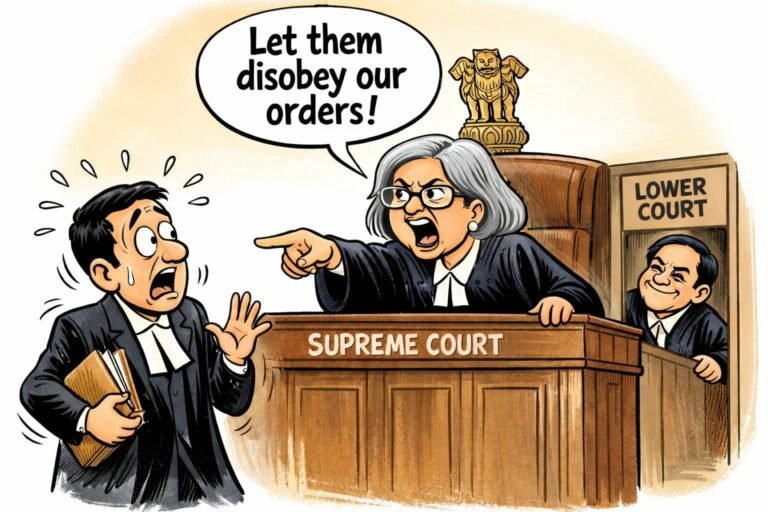
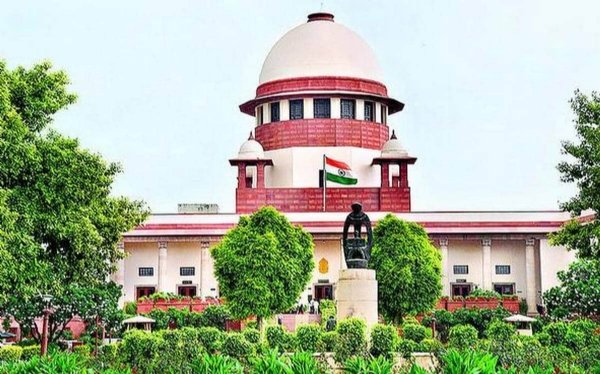
In a significant verdict aimed at restoring integrity within the legal profession, the Supreme Court has severely reprimanded the Bar Council of India (BCI) and set aside its “illegal, arbitrary and unjustified” order that had dismissed a misconduct complaint against an advocate without assigning any valid reasons. The Court has remanded the matter for fresh hearing, emphasising that adjudicatory bodies cannot function as mere “rubber stamps.”
The ruling comes in the backdrop of increasing concerns over Bar Councils allegedly protecting delinquent advocates by passing perfunctory and unreasoned orders. The Supreme Court’s decision, delivered in Sailesh Bhansali v. Alok Dhir, 2025 SCC OnLine SC 512, has provided what legal observers describe as a “much-needed corrective framework” to curb corruption and revive public faith in professional regulatory mechanisms. It is ruled by the Supreme Court that;
““2. This civil appeal is directed against the order dated March 30, 2024 passed by the Bar Council of India dismissing the appellant’s revision petition, whereby he questioned dismissal of his complaint (alleging professional misconduct committed by the respondent advocates) by the Bar Council of Delhi2 vide order dated October 5, 2015.
6.What follows from the above is that the ‘what’, i.e., the conclusion, must have the ‘why’, i.e., the reasons (at least in brief), to stand on, which is conspicuous by its absence in the impugned order of affirmation. On this short ground, we set aside the revisional order of the BCI.”
Growing Trend of Shielding Accused Advocates
Complaints of serious professional misconduct, including forgery, suppression of facts and misleading courts, have reportedly been brushed aside by certain Bar Council authorities. This trend, according to legal experts, has contributed to the erosion of public trust in the justice system.
The Indian Bar Association has announced a nationwide “Clean-Up Campaign” to address what it calls “deep-rooted structural corruption” within disciplinary bodies.
In the present case, the State Bar Council had dismissed—without proper reasoning—a complaint of professional misconduct against an advocate. Aggrieved citizens approached the BCI, which too rejected their appeal citing superficial and insufficient grounds.
Supreme Court: Reasoned Orders Are Mandatory, Not Optional
The Supreme Court has reiterated that every judicial or quasi-judicial authority must record clear, cogent and rational reasons before passing any order. The Court warned that cryptic or “rubber-stamp” orders are liable to be declared null and void.
Citing the landmark ruling in Neeharika Infrastructure Pvt. Ltd. v. State of Maharashtra, 2021 SCC OnLine SC 315 the Supreme Court reiterated that cryptic, mechanical, or “rubber-stamp” orders are liable to be declared null and void. The Court stressed that every adjudicating authority must provide clear, point-wise reasons reflecting due application of mind.
This principle was further reinforced in B.A. Linga Reddy v. Karnataka State Transport Authority, (2015) 4 SCC 515, where the Supreme Court emphasised the constitutional duty to issue a reasoned order. Referring to the Constitution Bench judgment in S.N. Mukherjee v. Union of India, the Court held:
“The purpose of disclosure of reasons is to ensure public confidence in judicial and quasi-judicial authorities. Unless reasons are disclosed, how can a litigant know whether the authority has applied its mind? Giving reasons minimises arbitrariness. It is an essential requirement of the rule of law that some reasons—at least in brief—must be recorded in every judicial or quasi-judicial order, even if the order merely affirms the earlier view.”
Recently this principle was reaffirmed in Vishal Ashwin Patel v. CIT, (2022) 14 SCC 817, it is ruled that in Vishal Ashwin Patel v. CIT, (2022) 14 SCC 817, categorically held that the Court or authority is duty-bound to deal with each issue raised and to pass a reasoned and speaking order by specifically recording the submissions of the parties, the applicable legal principles, and the findings forming the basis of the conclusion reached.
The Supreme Court reiterated the same principle in Municipal Board v. Kundanmal, AIR 2017 SC 2038, holding that a valid judicial or quasi-judicial order must necessarily contain the brief facts of the case, the grounds on which the action is challenged, the stand taken by the respective parties, the submissions advanced along with the legal provisions applicable to the controversy, and clear, reasoned findings indicating why a particular plea has been accepted or rejected. The Court observed that writ courts must decide petitions on merits through reasoned orders, failing which the order is unsustainable in law. In that case, the impugned order of the writ court was set aside and the matter was remanded for fresh adjudication. In the case of Hakim Nazir Ahmad v Commissioner 2025 SCC OnLine J&K the concerned officer was asked to go for training on how to write judgments with reasons.
Officials or Bar Council members who violate binding judicial norms and pass illegal orders may face contempt of court, including imprisonment up to six months under Sections 2(b) and 12 of the Contempt of Courts Act, 1971. Departmental action such as suspension, removal or disqualification from office may also follow.
The Court’s concerns were reinforced by earlier judgments, including:
- Harish Arora v. Registrar of Coop. Societies, 2025 SCC OnLine Bom 2833
- Priya Gupta v. Ministry of Health, (2013) 11 SCC 404
- Tata Mohan Rao v. S. Venkateswarlu, 2025 SCC OnLine SC 1105
- NDMC v. Prominent Hotel, 2015 SCC OnLine Del 11910
Forgery Alleged in Maharashtra Bar Council Case
In a related and rapidly escalating development, Advocate Sangram Desai, a sitting Member of the Bar Council of Maharashtra & Goa, has been accused of misusing his official position to unlawfully drop a serious disciplinary complaint against fellow Council Member Advocate Sudeep Pasbola—an advocate who is already facing grave criminal charges under IPC 409, an offence punishable with life imprisonment.
According to the allegations, Advocate Pasbola is embroiled in a deeper web of misconduct. It has been claimed that back-dated, fabricated, bogus, and forged documents, resolutions and orders were created by Adv. Pasbola in conspiracy with some other members with the malafide intent to protect himself from disciplinary proceedings arising out of grave accusations of professional misconduct. These allegations, point to a systemic abuse of institutional authority within the Bar Council and raise troubling questions about the integrity of regulatory processes meant to uphold professional standards among advocates.
Complainant Advocate Partho Sarkar has approached the Bombay High Court by filing Criminal Writ Petition No. 6393 of 2025, demanding stringent action against Advocate Sangram Desai for allegedly acting in violation of law and ethics. The matter is likely to be listed for hearing in the coming days, and observers within the legal fraternity are closely watching the Court’s response.
A Turning Point for Professional Accountability?
Many lawyers and legal scholars believe that this series of events could mark a decisive turning point in the push for stronger disciplinary reforms within Bar Councils. With the Supreme Court having unequivocally reaffirmed the necessity of transparency, reasoned decision-making, and adherence to due process, disciplinary bodies across the country are now under heightened scrutiny to enforce ethical standards without fear or favour.
The unfolding cases have sparked a renewed debate on whether Bar Councils have been sufficiently vigilant in dealing with allegations of misconduct, and whether internal checks and balances need urgent strengthening to prevent abuse of authority by those holding statutory positions.
The Indian Bar Association has declared that it will intensify its efforts to ensure the “purification of the legal profession” and will advocate for stringent measures against advocates who misuse their position, engage in unethical practices, or attempt to undermine the justice system.