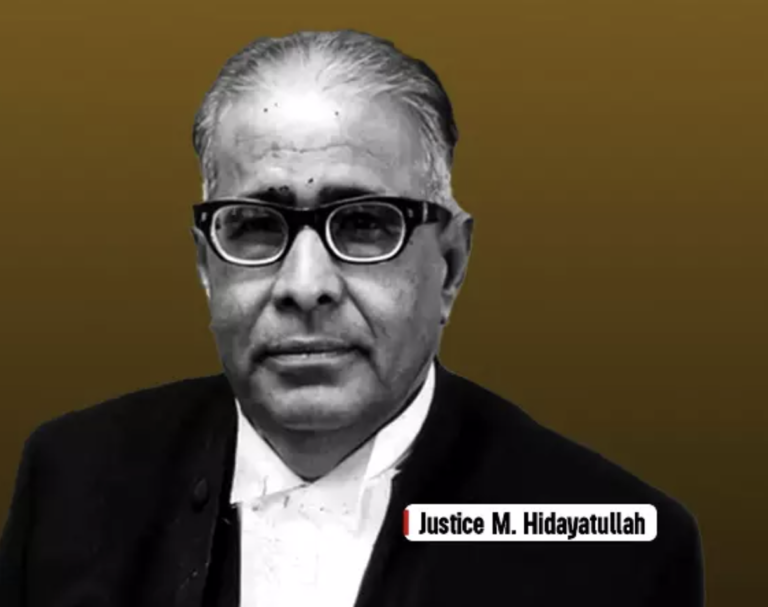
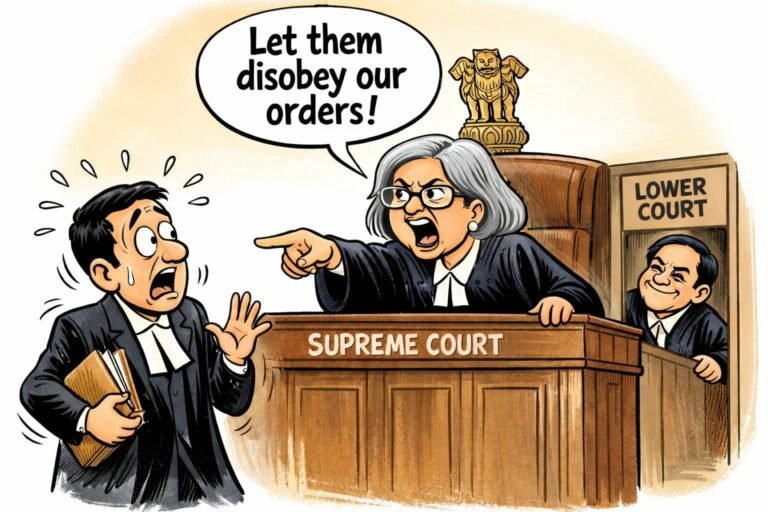
[Shocking] A two-judge Bench headed by Justice B.V. Nagarathna dismissed a petition filed in accordance with the law laid down by the Constitution Bench in In Re: C.S. Karnan, (2017) 7 SCC 1, imposed costs on the petitioner, and made discourteous and intimidating remarks cautioning advocates who in fact had filed the petition as per law settled by the larger benches.
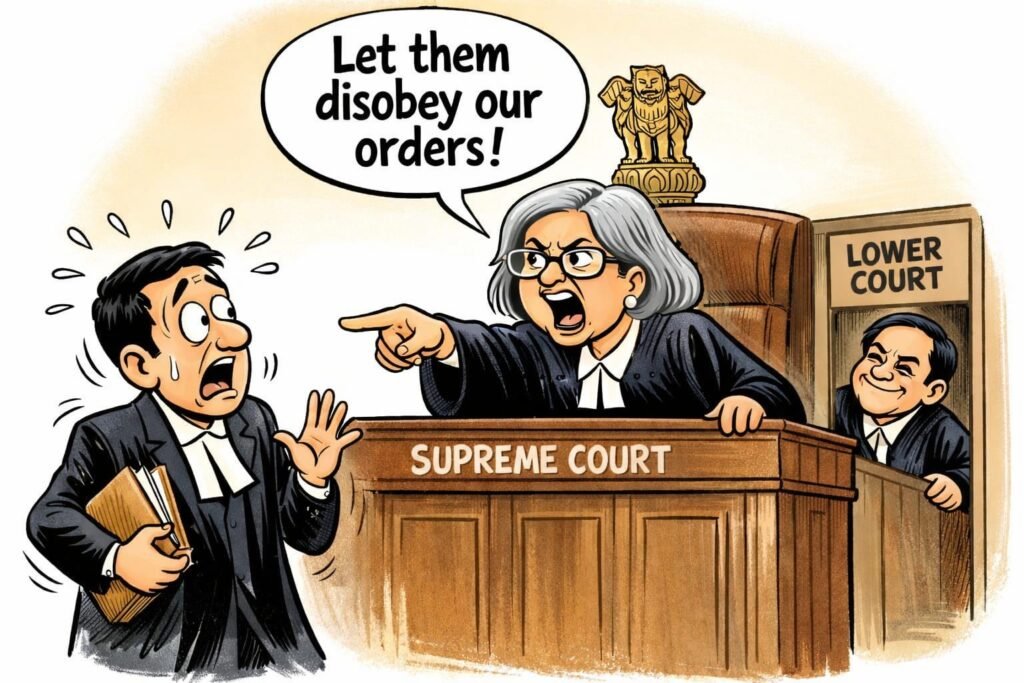
The Indian Lawyers and Human Rights Activists Association has filed a complaint before the Hon’ble Chief Justice of India, seeking appropriate action, including prosecution in accordance with law, against Justice B.V. Nagarathna. The complaint cites several instances where the learned judge allegedly acted contrary to binding Supreme Court precedents and displayed angry and threatening conduct towards citizens and advocates in court. According to the Association, such behaviour creates an intimidating and hostile courtroom environment that undermines the constitutional right of litigants to a fair and dignified hearing and adversely affects the independence of the Bar, as it may deter advocates from representing their clients fearlessly and effectively. The Association has requested the Chief Justice to examine the matter and take appropriate corrective action immediately to save the dignity of the Supreme Court.
The complaint placed before the Hon’ble Chief Justice of India, Justice Surya Kant, raises serious concerns as to whether the episode reflects judicial adventurism or lack of basic knowledge or proper understanding of the settled principles of law by the learned Judge.
In Shikhar Chemicals v. State of U.P., 2025 SCC OnLine SC 1653, the Supreme Court directed the Chief Justice of the concerned High Court to withdraw the criminal assignment from a High Court judge, observing concerns regarding the judge’s level of understanding in dealing with criminal matters.
The constitutional protections recognized under the International Covenant on Civil and Political Rights (ICCPR) and the Universal Declaration of Human Rights (UDHR), as acknowledged in India in Sovaran Singh Prajapati v. State of U.P., 2025 SCC OnLine SC 351, guarantee every citizen the right to have his or her case adjudicated by a fair, competent, and impartial judge.
Similarly, in Supdt. of Central Excise v. Somabhai Ranchhodhbhai Patel, (2001) 5 SCC 65, the Hon’ble Supreme Court emphasized that the level of understanding and competence of a judge has a direct bearing on the rights of litigants appearing before the court, as judicial orders and decisions profoundly affect their legal rights, liberties, and interests.
Supreme Court has already warned that the discourteous Judges should be removed from the judiciary as they are ill tuned instrument fitted in the court hall. It further ruled that a bad behavior of one Judge is having a rippling effect of on entire judicial system. [R.K. Garg v. State of Himachal Pradesh, (1981) 3 SCC 166 C. Ravichandran Iyer v. Justice A.M. Bhattacharjee, (1995) 5 SCC 457.]
The Supreme Court has held that advocates are officers of the court and equal partners in the administration of justice. No one is superior and no one is inferior. Judges are therefore obliged to treat advocates with the same dignity, courtesy and respect they expect for themselves. Advocates do not appear before courts seeking favour but to assert the legal rights of their clients and assist in the administration of justice. Advocates do not appear before a court to seek favours or charity. They appear to vindicate the legal rights of their clients and assist the court in the cause of justice. Judges, on the other hand, are constitutionally entrusted with the responsibility of ensuring fairness and protecting the rights of citizens. Even when confronted with difficult situations, and even when their patience is tested the judicial code of conduct requires restraint, patience, and courtesy. A judge may reject a petition in accordance with law, but intimidation, humiliation, or discourteous behavior towards advocates or litigants has no place in the administration of justice. Courts are not arenas of authority where parties and lawyers stand at the mercy of the Judicial Officer; they are institutions meant to uphold the rule of law with dignity and fairness. Any act of misconduct or intimidation directed at an advocate, litigant, or citizen in court are not protected as it is not a part of their official duty. The erring Judge may face legal consequences, including proceedings for contempt of court, defamation, criminal intimidation, or civil liability for damages apart from disciplinary action regarding removal from service and impeachment proceedings.
[Muhammad Shafi v. Choudhary Qadir Bakhsh, 1949 SCC OnLine Lah 14 Bidhi Singh v. M.S. Mandyal, 1993 Cri LJ 499 ; B.S. Sambhu v. T.S. Krishnaswamy, (1983) 1 SCC 11 ; Mehmood Nayyar Azam v. State of Chhattisgarh, (2012) 8 SCC 1; Latief Ahmad Rather v. Shafeeqa Bhat, 2022 SCC OnLine J&K 249 Ghanshyam Upadhyay v. State of Maharashtra, 2017 SCC OnLine Bom 9984 ; Harish Chandra Mishra v. Hon’ble Mr. Justice S. Ali Ahmed, 1985 SCC OnLine Pat 213 ; R. Muthukrishnan v. High Court of Madras, (2019) 16 SCC 407; High Court of Karnataka Vs. Jai Chaitanya Dasa & Others 2015 (3) AKR 627, ; Chetak Construction Ltd. v. Om Prakash, (1998) 4 SCC 577; ; Ramesh Lawrence Maharaj v. Attorney General of Trinidad & Tobago, (1978) 2 WLR 902 ; McLeod v. St. Aubyn, [1899] AC 549 ; Walmik Bobde v. State of Maharashtra, 2001 ALL MR (Cri) 1731 Sailajanand Pande v. Suresh Chandra Gupta, 1968 SCC OnLine Pat 49 : AIR 1968 Pat 194.]
Justice B.V. Nagarathna has drawn strong criticism from sections of the legal fraternity for her alleged extremely rude conduct towards a poor litigant and for imposing ₹1 lakh costs on a financially distressed father who had approached the Supreme Court seeking relief for the admission of his daughters, as he was unable to afford their school fees.
During the proceedings, he was subjected to humiliating and insulting treatment in court and was further threatened with the imposition of an additional cost of ₹10 lakh merely for approaching the Supreme Court. Despite his emotional plea, made with folded hands and tears, his request was rejected in a manner which was harsh and lacking compassion. The issue raised concerns not only regarding the violation of the fundamental right to a fair hearing with dignity but also regarding the insensitivity displayed by Justice Nagarathna. The video recording of the said incident, along with four other similar incidents reflecting arbitrary and improper conduct, and grossly unlawful, orders has already been submitted to the Chief Justice of India by the Indian Lawyers & Human Rights Activists Association (ILHRAA).
1. Brief Summary of the case: –
1.1 A District Judge failed and refused to comply with the specific directions issued by the Hon’ble Supreme Court. In view of such wilful non-compliance with the binding orders of the Apex Court, the Petitioner, Mr. Rajeev Bansal, was constrained to approach the Hon’ble Supreme Court by filing a Contempt Petition bearing Cont. Petition (L) No. 766 of 2025 in SLP (L) No. 13255 of 2025, seeking appropriate action for disobedience of the orders of the Hon’ble Supreme Court.
1.2 The said Contempt Petition came up for hearing on 17.11.2025 before a Bench comprising Ld. Justices Smt. B.V. Nagarathna and Shri R. Mahadevan. During the course of hearing, the Bench, particularly Hon’ble Justice B.V. Nagarathna, expressed strong displeasure and observed in an intimidating tone that no contempt petition is maintainable against subordinate court judges even if they refuse to obey the orders of the Hon’ble Supreme Court. The Bench further observed that the only remedy available to the Petitioner would be to prefer an appeal before the concerned High Court The bench dismissed the petition with cost of Rs. 5,000/-.
1.3 Not only this, the learned Judges went further to caution and warn the advocates present that they should not encourage or assist litigants in filing such petitions and that action could be taken against advocates who facilitate or support the filing of such petitions. The Bench also cautioned members of the Bar against encouraging litigants to file what were described as misguided petitions.
1.4 The order dated 17. 11. 2025 passed by the Bench of Justices in the matter between Rajeev Bansal & Anr. Vs Gaurav Mahajan reads thus;
“1.When we queried learned counsel for the petitioners, Mr. L.B. Rai as to how a Contempt Petition was maintainable against an Additional District Judge with regard to “not obeying the order of this Court”, the learned counsel responded by seeking withdrawal of the Contempt Petition.
2.In our view, the very filing of this Contempt Petition is an abuse of the process of this Court.
3.Hence, the Contempt Petition is dismissed with nominal cost of Rs.5,000/-(Rupees Five Thousand Only) payable to the Supreme Court Legal Services Committee within a period of two weeks from today.”
1.5 The above position is highly shocking and contrary to the settled legal framework governing contempt jurisdiction. The Sec 2(b) of the Contempt of Courts Act, 1971, along with several binding judgments of the Hon’ble Supreme Court, clearly establishes that wilful disobedience of the orders of the Hon’ble Supreme Court by any court or authority, including judges of subordinate courts, constitutes civil contempt. [ Re. M.P. Dwivedi (1996) 4 SCC 152, Re C S Karnan (2017) 7 SCC 1, Atma Ram Builders (P) Ltd. v. A.K. Tuli, (2011) 6 SCC 385, Baradakanta Misra v. Bhimsen Dixit, (1973) 1 SCC 446 , Prabha Sharma Vs Sunil Goyal (2017) 11 SCC 77] .
These judgments clearly hold that any person, including a judicial officer, who wilfully disobeys the binding directions of the Hon’ble Supreme Court can be proceeded against for civil contempt. Such acts may attract consequences under Sections 2(b), 12 and 16 of the Contempt of Courts Act, 1971, which specifically recognize that judges and judicial officers are not immune from contempt jurisdiction where there is wilful disobedience of binding judicial orders.
2. The Hon’ble Supreme Court has repeatedly held that its directions, orders, and guidelines are binding on all courts under Article 141 of the Constitution of India and any judge who wilfully disobeys or refuses to comply with the binding directions, orders, and guidelines issued by the Hon’ble Supreme Court may be held guilty of contempt of court and may further be subjected to disciplinary proceedings, including dismissal from judicial service
3. In Subrata Roy Sahara v. Union of India, (2014) 8 SCC 470 it is ruled that if a two-Judge Bench of the Supreme Court refuses to follow the order of a three-Judge Bench, then such conduct of the Two-Judge Bench would be guilty of contempt of court.
4. In Som Mittal v. Govt. of Karnataka, (2008) 3 SCC 574 Full Bench ruled that the Hon’ble Supreme Court Benches before passing any order are bound to verify that their order does not conflict with the binding precedent of the Hon’ble Supreme Court and also does not create any confusion about the binding precedents.
5. Even otherwise, under Sections 217, 218, 219 and 166 of the Indian Penal Code, 1860 (now corresponding to Sections 255, 256, 257 and 198 of the Bharatiya Nyaya Sanhita, 2023), if any public servant, including a judicial officer, knowingly passes an order contrary to law with the intention of saving a wrongdoer or causing injury or injustice to any person, such conduct may attract criminal liability and prosecution, which may extend to punishment up to seven years of imprisonment in accordance with law.
6. In Nirbhay Singh Suliya v. State of M.P., 2026 SCC OnLine SC 8 the Supreme Court Ruled that the guilty and tainted Judges must face the Criminal Prosecution to save the image of the judicial institution.
7. In New Delhi Municipal Council Vs. Prominent Hotel, 2015 SCC OnLine Del 11910 the Judgements of the action of the contempt against a Judge are summarized in detail.
8. The case of District Judge Archana Sinha, is relevant in this context. In Atma Ram Builders (P) Ltd. v. A.K. Tuli, (2011) 6 SCC 385 a Bench of the Hon’ble Supreme Court presided over by Justice Markandey Katju warned the concerned District Judge of possible imprisonment for contempt for failing to comply with the directions of the Hon’ble Supreme Court. The Court further observed that subordinate judges who deliberately disregard the binding directions of the Supreme Court are bringing a bad name to the whole institution and must be thrown out of the judiciary.
9. In the case of Prabha Sharma Vs Sunil Goyal (2017) 11 SCC 77 Supreme Court held that the Judge not following Supreme Court orders and general guidelines should face Disciplinary action. In Harish Arora v. Registrar of Coop. Societies, 2025 SCC OnLine Bom 2833 it is ruled that such Judge will be guilty of “Legal Malice” as it represents an abuse or misuse of legal authority in disregard of the established principles of law and such judges must face disciplinary action.
10.in the case of Nikhil Jain v. State (NCT of Delhi), 2025 SCC OnLine Del 6150 the Delhi High Court found serious concerns regarding judicial indiscipline where subordinate courts appeared to have ignored binding orders of the High Court and the Supreme Court while granting undeserving protection to the accused. The Court noted that despite the anticipatory bail applications having already been rejected twice by the High Court and the rejection having been upheld by the Supreme Court, the Magistrate and the Additional Sessions Judge granted relief to the accused and observed that the conduct indicated judicial indiscipline and disregard of binding precedents. Accordingly, the Court dismissed the anticipatory bail application and directed that copies of the order be sent to the Registrar General of the Delhi High Court for placing the matter before the Inspecting Committees of the concerned judicial officers, and also to the Commissioner of Police for necessary action.
11.In a recent judgment in the case of Netsity Systems (P) Ltd. v. State (NCT of Delhi), 2025 SCC OnLine SC 2079, the Hon’ble Supreme Court expressed serious concern regarding the manner in which the ACMM unlawfully granted bail in disregard of the binding precedents and the Sessions Judge declined to interfere with that illegal order. The Court observed that the judicial orders reflected a lack of proper appreciation of binding precedents and the approach expected while dealing with matters involving decisions of superior courts. Consequently, the Supreme Court directed that the concerned judicial officers undergo special judicial training for at least seven days at the Delhi Judicial Academy, with specific emphasis on sensitizing them about the conduct of judicial proceedings and the appropriate weight to be accorded to decisions of superior courts. The Court also requested the Chief Justice of the Delhi High Court and the Judicial Education & Training Programme Committee to make the necessary arrangements for such training.
12.In Rohit Kumar v. State (NCT of Delhi), 2007 SCC OnLine Del 1381, the Delhi High Court held that the observations made by the trial court were in clear disobedience of the High Court’s earlier order and bordered on contempt of court. The Court further observed that the concerned Additional Sessions Judge lacked even elementary knowledge of the Code of Criminal Procedure while passing the impugned order. In view of these serious deficiencies, the High Court directed that the judicial officer undergo a refresher training course in criminal law and procedure at the Delhi Judicial Academy for at least three months, under the supervision of the Director of the Academy, with a performance report to be submitted to the Court. The Court also directed that the judgment be circulated to all judicial officers in Delhi for guidance and that a copy be placed in the personal file of the concerned officer.
13.In New Delhi Municipal Council Vs. Prominent Hotel, 2015 SCC OnLine Del 11910, the Delhi High Court summarised various judgments of the Supreme Court and High Courts concerning the duty of subordinate courts to follow binding precedents of the High Court and the Supreme Court. The judgment further noted that where a judicial officer knowingly ignores or bypasses binding decisions of superior courts, such conduct may not be treated as a mere error of judgment but can amount to contempt of court, warranting appropriate action to preserve the authority and integrity of the judicial hierarchy.
14.In Suman Sankar Bhunia v. Debarati Bhunia Chakraborty, 2025 SCC OnLine Del 8692, the Delhi High Court strongly criticised the conduct of the concerned Family Court Judge, observing that the proceedings reflected a serious lack of understanding of basic legal principles, statutory provisions, and jurisdictional limits. The Court held that such misapprehension of law and judicial authority undermined the integrity of the adjudicatory process. Consequently, the High Court directed that the concerned judicial officer undergo an immediate and comprehensive refresher training in matrimonial laws at the Delhi Judicial Academy before adjudicating any further matrimonial matters, and ordered the Registry to communicate the judgment to the appropriate authorities for necessary action.
Earlier, a major controversy had arisen in a similar case over the harsh and threatening remarks made by Justice Ahsanuddin Amanullah in the Patanjali matter. On that occasion, several Supreme Court judges and former Chief Justices publicly expressed strong disagreement and deep concern through an article published in The Times of India, and advised that the legal principles on judicial conduct laid down in C. Ravichandran Iyer v. Justice A. M. Bhattacharjee (1995) 5 SCC 457 be read and followed.
Title: SC judge’s ‘rip you apart’ comment riles present, former judges
In this context, comparisons are being drawn between the alleged conduct of Chief Justice Surya Kant and Justice Nagarathna. Recently, during the hearing of the writ petition Mathew Nedumpara v. Supreme Court of India, filed under Article 32 of the Constitution, Chief Justice Surya Kant heard the petitioner’s submissions with complete calm and patience, in a manner consistent with the dignity of the Supreme Court. While maintaining courtroom decorum, he also informed the petitioner that if legal assistance was required, the services of a senior advocate could be arranged so that the case could be presented properly and effectively. The petition was thereafter dismissed on the basis of law and the record.
Although the Chief Justice disagreed with the petitioner’s submissions, his conduct was in no way disrespectful. Even though the order went against the petitioner, there were no personal remarks, reprimands, or expressions that could injure the petitioner’s dignity. Nor was any punitive cost — such as a fine of one lakh rupees — imposed.
In stark and deeply troubling contrast, it is alleged that Justice Nagarathna and Justice Ujjal Bhuyan treated the same poor complainant — a father who had come seeking justice for his daughter — in a manner that was entirely different, humiliating and wholly unworthy of the nation’s highest court.
Justice Nagarathna Allegedly Did the Exact Opposite to the prohibition laid down in the case of P. Radhakrishnan & Anr. v. Cochin Devaswom Board & Ors., 2025 INSC 1183
The Supreme Court in P. Radhakrishnan & Anr. v. Cochin Devaswom Board & Ors., 2025 INSC 1183 held that if a bench takes parties by surprise, makes strong observations and directions, it will create a chilling effect on prospective litigants. They will be left to wonder — “if I go to court seeking justice, will I leave worse off than before?” The Supreme Court warned that this could seriously impact access to justice and consequently the very rule of law — and directed that courts must exercise great caution and circumspection. That is the law. That is the binding standard set by the Supreme Court itself.
And according to the complaint — Justice Nagarathna violated every word of it.
A Poor Father. A Daughter. A Fight for Free Education. And Then — This.
The facts of this case are as simple as they are heartbreaking.
A poor father approached the Supreme Court seeking admission for his daughter under the Right to Education Act — free education that the Constitution itself guarantees to every child. He was not a wealthy litigant gaming the system. He was not a frivolous petitioner wasting the court’s time. He was a father who could not afford school fees — and who believed, with complete faith, that the Constitution of India stood behind him and his daughter.
He came to the Supreme Court as a citizen exercising his fundamental right.
What he allegedly received in return was intimidation, humiliation, threats — and a punitive cost of Rs. 1,00,000.
A man who came to court because he could not pay school fees was ordered to pay one lakh rupees.
He left the Supreme Court worse off — financially, emotionally and constitutionally — than the day he arrived.
This is precisely the situation the Supreme Court in P. Radhakrishnan declared must never be allowed to happen.
This Is Not Judicial Error. This Is a Constitutional Breach.
According to the complaint, Justice Nagarathna did not merely make a mistake in judgment.
She allegedly:
— Insulted, threatened, intimidated and publicly humiliated a poor father inside the Supreme Court, — Imposed a punitive cost of Rs. 1 lakh on a man who came seeking free education for his daughter under the RTE Act, — Violated the binding guidelines of the Supreme Court’s own Constitutional Bench, — Breached her solemn oath of office — to act fairly, to uphold the law and to protect the Constitution of India, and — Committed contempt of the Supreme Court’s own binding directions on judicial conduct and courtroom decorum.
That is not a judicial order. That is an abuse of judicial power. That is not a strict judge. That is a constitutional violation. That is not justice. That is the destruction of access to justice — from within the walls of the institution sworn to protect it.
The Chilling Effect — Already Here, Already Spreading
The Supreme Court warned of a chilling effect.
According to the complaint, that chilling effect is no longer a theoretical risk. It has arrived. It is real. It is documented. It is on video.
Every poor citizen watching this case is now asking themselves —
“If a father who sought free education for his daughter under the RTE Act was humiliated and fined one lakh rupees — should I even bother going to court?”
Every advocate watching this case is asking —
“If I appear before a bench and speak up for my client — will I face threats and public humiliation?”
That is the chilling effect the Supreme Court feared. And according to the complaint — Justice Nagarathna created it.
The Oath She Took is breached. The Law She Violated.
Every judge of the Supreme Court of India takes a solemn constitutional oath — To bear true faith and allegiance to the Constitution. To uphold the sovereignty and integrity of India. To duly and faithfully perform the duties of the office to the best of ability, knowledge and judgment — without fear or favour, affection or ill-will.
According to the complaint, that oath was broken in that courtroom by the judge herself.
The law is clear. The breach is documented. The nation is watching. Justice must now be done — and it must be seen to be done.
Three Demands — Clear, Firm and Non-Negotiable
ILHRAA has placed three principal demands before the authorities:
1. Immediate intervention and stringent action for the alleged violation of the constitutional right to a fair and respectful hearing.
2. Directions to the National Judicial Academy to prepare and widely circulate a comprehensive handbook on judicial conduct and courtroom decorum.
3. The Attorney General of India and investigative agencies including the Central Bureau of Investigation to take legal cognizance and register contempt of court as well as criminal proceedings without delay.
One reassuring feature of India’s constitutional democracy is that whenever a judge is seen to have crossed the line of judicial propriety, the legal fraternity and vigilant sections of society have stood up. Advocates, citizens, and even members within the judiciary have raised their voices to demand accountability and corrective action against errant or discourteous judicial conduct.
When Justice Nariman threatened to throw a lawyer from the courtroom — Justice Markandey Katju wrote an open letter and publicly reminded the judiciary what civilised conduct demands and how the behaviour of Judges should be.
When Justice Arun Mishra was accused of misconduct toward Senior Counsel Shankarnarayanan — the Supreme Court Bar Association stepped in with a strong objection. Justice Mishra responded with remarkable grace, offering a public apology before the nation.
The complaint also references the alleged discourteous and threatening conduct of Justice Vikram Nath toward Senior Advocate Raju Ramachandran — and documents similar alleged misconduct against 16 other advocates, including women advocates from Scheduled Caste and backward communities, the National President of the Indian Bar Association, and the National President of the Rashtriya Samvidhan Raksha Samiti, Shri Nilesh Ojha. Formal complaints by Lawyers and Human Rights have already been filed Associations in all these matters, before the relevant authorities.
And then there is the incident that shook the conscience of the legal fraternity — a young advocate at the Bombay High Court collapsed and fainted inside the courtroom after being threatened by a judge. In the aftermath, former Chief Justice Bhushan Gavai felt compelled to state publicly –
“Judges are not feudal lords.”
Chief Justice of India Suryakant gave that message with more clarity —
“The judiciary exists to serve the citizens — not to intimidate them.”
Chief Justice Shri Surya Kant, in a public address in Mumbai, reminded the judiciary that the justice system must be guided by restraint, courtesy, respect, and compassion, especially when dealing with the poor and marginalized. He stated that a court is not merely a physical structure but a “living institutional culture,” where disagreement must never degenerate into disrespect.
He also warned that the way advocates are treated and the manner in which hearings are conducted either strengthens or weakens public confidence in the judiciary every day. According to him, mutual respect and cooperation between the Bench and the Bar are not optional values but foundational principles of the justice system.
Against this backdrop, the complaint asks a troubling question: if these standards are the very values that the judiciary itself proclaims, why were they allegedly ignored, and why are those accused of breaching them still permitted to continue exercising judicial authority over the fate of ordinary citizens?