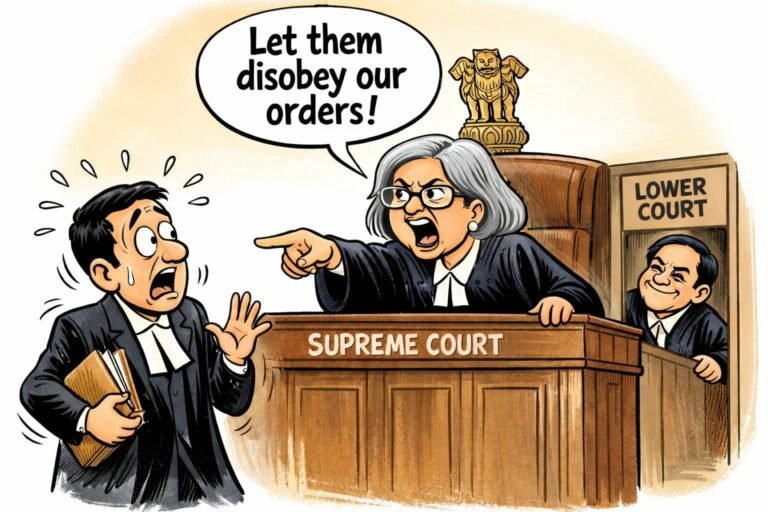
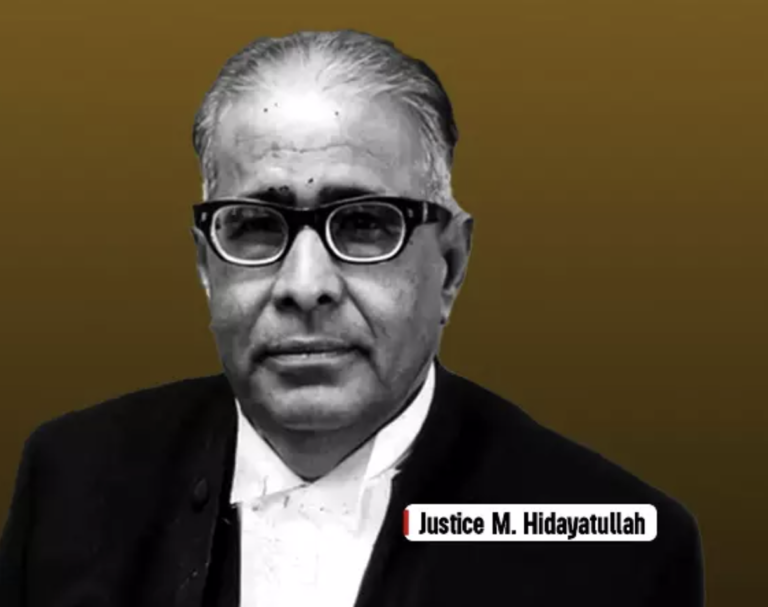
Justice Hidayatullah’s view in 1966 in Naresh Mirajkar’s case was binding precedent as being undisputed and no counter precedent available and Now has become the Binding Law of the Land as Nine-Judge Constitution Bench in Puttaswamy (2017) Confirms
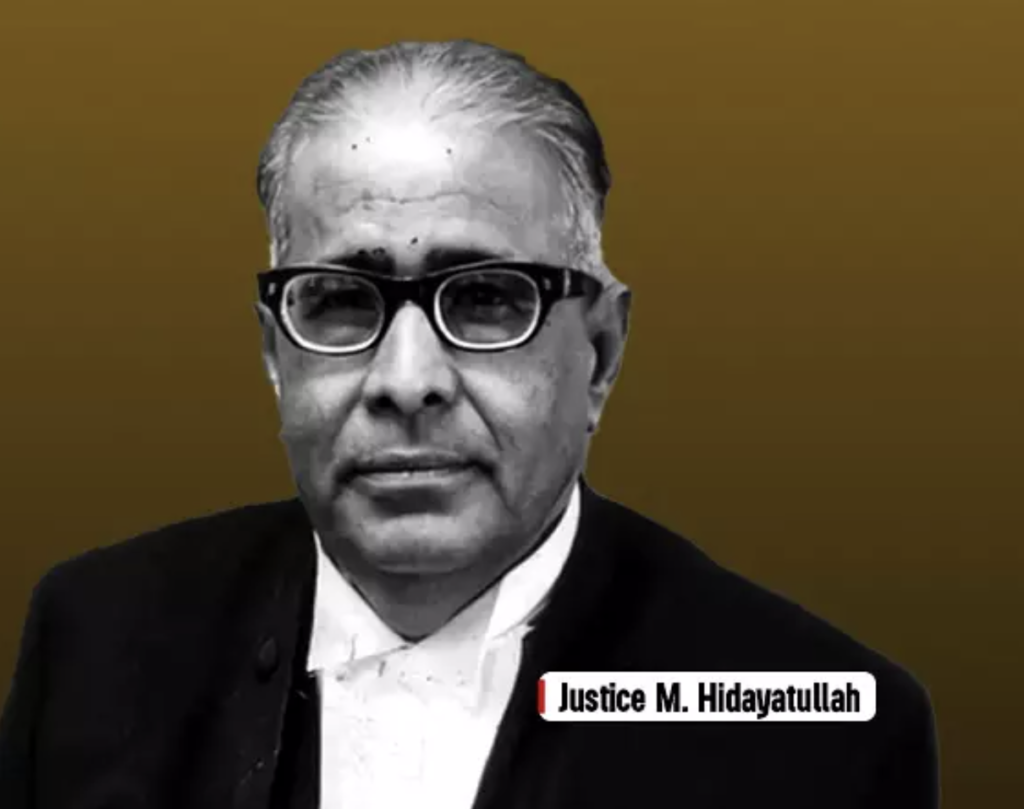
Now if a Judge of any Court Violates Your Fundamental Rights Through Words Spoken from the Bench OR Orders passed then Anyone Can File a Writ Petition and can Claim Compensation.
A Constitutional Vision Overlooked by Jurists and Courts Alike for Six Decades — Now Demands and Deserves Full, Unreserved and Authoritative Recognition.
An Article by :-
Adv. Nilesh Ojha National President, Indian Bar Association – National President, Rashtriya Samvidhan Raksha Samiti (RSRS) & Adv. Ishwarlal Agarwal Chairman, Supreme Court Lawyers Association.
Mumbai:- Justice Hidayatullah’s extraordinary constitutional vision, delivered from the highest bench in the land in 1966, suffered a fate that is as unfortunate as it is instructive. For decades, it lay buried beneath the weight of the majority opinion in Naresh Shridhar Mirajkar v. State of Maharashtra, 1966 SCC OnLine SC 10, — overlooked, underappreciated and largely invisible to the mainstream of Indian legal scholarship and judicial practice. Many jurists who cited Mirajkar cited only the majority. Many courts that applied Mirajkar applied only its narrow ratio. The deeper, broader and ultimately more significant constitutional contribution of Justice Hidayatullah — his careful, reasoned and unchallenged answer to the very question the majority declined to address — was left in the shadows.
In 1966, when a nine-judge Constitution Bench of the Supreme Court of India delivered its judgment in Naresh Shridhar Mirajkar v. State of Maharashtra, 1966 SCC OnLine SC 10, the majority confined itself to a narrow question — whether a judicial order of injunction restraining publication of court proceedings violated the fundamental rights of citizens under Article 19 of the Constitution.
The majority answered in the negative. They held that judicial orders, being judicial acts, do not attract the writ jurisdiction of the Supreme Court under Article 32 in the same manner as executive or legislative action.
But one judge saw further. One judge asked a deeper question. And one judge gave an answer that the rest of the bench did not dispute — an answer that has now, five decades later, become the binding law of this land.That judge was Justice M. Hidayatullah.
What the Majority Said — And What It Deliberately Left Open
The majority in Mirajkar was careful and deliberate in limiting the scope of its ruling. The bench confined itself to the question of violation of rights under Article 19 — the freedom of speech, expression and profession. It expressly declined to examine whether judicial orders could violate fundamental rights guaranteed under Articles 14, 20, 21 and 22 of the Constitution.
This was not an oversight. It was a conscious choice. The majority effectively said — we are not deciding that question today.
But Justice Hidayatullah decided it anyway. In his independent opinion — spanning paragraphs 88 to 132 of the judgment — he addressed the very question the majority left open. And he addressed it with a clarity and constitutional vision that was, and remains, unmatched.
He gave a concrete and vivid illustration —
Example 1 — Article 22(1): Right to Counsel
If a High Court insisted that a defendant in a criminal case take a counsel of the court’s choice rather than counsel of his own choice — this would vitiate the trial because of breach of the fundamental right under Article 22(1). And the remedy would not be to wait till the end of the trial and then appeal — but to immediately seek a writ compelling observance of the Constitution.
Example 2 — Article 14: Exclusion from Courtroom on Grounds of Political Party
If a judge, without any reason, orders members of a particular political party out of his court — those so ordered may seek to enforce their fundamental rights against the judge. And it makes no difference that the order was made while the judge sat in his judicial capacity.
Example 3 — Article 14/15: Exclusion from Courtroom on Grounds of Race, Religion or Community
A courtroom is a place dedicated to the use of the general public. A judge cannot exclude a section of the public on the ground of race, religion or community without offending fundamental rights. Such exclusion would be a clear breach of the right of equal protection guaranteed by the Constitution.
Example 4 — Article 19(1)(a): Suppression of Press Reporting of Public Trial
Just as denial of the right to enter a court deprives a person of several fundamental freedoms — denial of the right to publish reports of a public trial is a denial of freedom of the press, which is included in the freedom of speech and expression under Article 19(1)(a). If a judge singles out some newspapers for discriminatory treatment, the order would offend the equality clause. A writ would lie to quash such an order.
Example 5 — Article 19(1)(g): Right to Carry on Profession of Law
The right to carry on the profession of law may be enforced against a judge within the precincts of his court — just as the carrying on of other professions may be enforced outside the court. A judge cannot, by his conduct or orders, deprive an advocate of his right to practice.
Example 6 — Article 20: Conviction, Punishment and Testimonial Compulsion
Article 20, which speaks of convictions for offences, punishments and testimonial compulsion, is addressed as much to courts as to the executive. Justice Hidayatullah pointedly observed — “I venture to think that the worst offenders would be the courts if they went against this prescription.”
Example 7 — Article 22(1): Denial of Right to Chosen Legal Practitioner
If a court denied a person who is arrested the right to be defended by a legal practitioner of his choice — the trial would be vitiated. The remedy would not be appeal after the trial — but an immediate writ compelling observance of the fundamental right.
The Overarching Principle Justice Hidayatullah Derived from These Examples
From all these examples, Justice Hidayatullah derived one clear and overarching constitutional principle —
“In the context of Articles 14, 15(1)(b) and 19(a) and (d) it is easy to visualize breaches by almost any one including a Judge.”
And —
“Other cases can easily be imagined under Articles 14, 15, 19, 20, 21 and 22 of the Constitution in which there may be action by a Judge which may offend the fundamental rights and in which an appeal to this Court will not only be not practicable but also quite an ineffective remedy.”
The Key Distinction He Drew
Justice Hidayatullah drew a crucial distinction between two types of judicial acts:
Type 1 — Acts done impersonally and objectively between parties in the ordinary course of civil or criminal proceedings. These are challengeable only under ordinary law — by appeal, revision or review.
Type 2 — Acts where the court becomes involved collaterally with a fundamental right of a person — whether litigant, advocate, spectator or press. These are not merely wrong judicial orders. These are breaches of fundamental rights pure and simple — and a writ under Article 32 is both available and the appropriate remedy.
Crucially, Justice Hidayatullah’s opinion on this issue — namely, the applicability of Fundamental Rights against judicial action under Articles 14, 20, 21 and 22 — was neither challenged nor contradicted by any other member of the nine-judge Bench. The majority deliberately confined its determination to Article 19 and left the broader constitutional question open. Justice Hidayatullah addressed that question directly, and no member of the Bench expressed disagreement with his reasoning.
Accordingly, on this specific point, his view may legitimately be treated as possessing authoritative precedential value. This position is supported by the law laid down by the Constitution Bench in Sarwan Singh Lamba & Ors. v. Union of India & Anr., (1995) 4 SCC 546, and Union of India & Ors. v. S.P. Sharma & Ors., (2014) 6 SCC 351, wherein it was held that obiter dicta of a Judge of the Supreme Court — even in a dissenting opinion — are entitled to the highest respect and may be relied upon, particularly where there is no direct decision of the Supreme Court conclusively deciding the said question under the relevant enactment.
[See also :– Kaikhosrou(Chick) Kavasji Framji And … vs Union Of India AIR 2019 SUPREME COURT 1692, The Guardians of the Poor of the West Derby Union vs. The Guardians of the Poor of the Atcham Union 1889 (Vol. XXIV) page 117. ]
The Logical and Legal Conclusion
Justice Hidayatullah’s view that —
— Judges are not entirely outside the reach of fundamental rights, — Judicial action can violate rights under Articles 14, 20, 21 and 22, — Where such violation occurs and ordinary remedies are unavailable or ineffective, a writ under Article 32 is both available and the appropriate remedy, and — This Court is not only empowered but obligated to act when fundamental rights are trampled upon, – was unchallenged on the day it was delivered in 1966, uncontradicted in law .
Twelve years after Mirajkar, the Judicial Committee of the Privy Council took Justice Hidayatullah’s constitutional principle to its logical and necessary conclusion.
In Ramesh Lawrence Maharaj v. Attorney General of Trinidad & Tobago, (1978) 2 WLR 902, the Privy Council held that where a judge passes an order of conviction for contempt without framing a charge — thereby violating the accused’s right to a trial as per procedure prescribed by law — the court in its writ jurisdiction is bound to order the State to pay compensation to the victim.
The constitutional reasoning was fundamental and unassailable — the judiciary is the executive arm of the State. When a judicial officer violates a citizen’s rights, the State is vicariously liable. The victim is entitled to compensation. The writ court has not merely the power — it has the duty — to enforce that entitlement.
Indian courts embraced this principle unreservedly and expanded it through a powerful and unbroken line of landmark decisions — each one following the ratio of Ramesh Lawrence Maharaj with approval and taking it further.
In Smt. Nilabati Behera v. State of Orissa, (1993) 2 SCC 746 and Shri D.K. Basu v. State of West Bengal, (1997) 1 SCC 416, the Supreme Court reinforced with full constitutional force the principle that where the State — through any of its organs — violates a citizen’s fundamental rights, the constitutional courts are empowered and indeed obligated to award compensation as a public law remedy. The organ does not matter. The liability does.
In Supreme Court of India v. Subhash Chandra Agarwal, (2020) 5 SCC 481, a Constitution Bench of the Supreme Court ruled categorically that all judges including Judges of the Supreme Court are public servants — and cannot claim any exception from the obligations and accountabilities that flow from that status.
In Walmik Bobde v. State of Maharashtra, 2001 ALL MR (Cri) 1731, compensation was awarded in circumstances directly and squarely arising from judicial error — affirming beyond doubt that even mistakes of a judge that cause harm to a citizen’s fundamental rights attract the court’s compensatory jurisdiction. The robe provides no immunity from the Constitution.
Ram Deo Chauhan — The Supreme Court Confronts Itself
In Ram Deo Chauhan v. Bani Kanta Das, (2010) 14 SCC 209, the Supreme Court took the principle to a destination that was as historic as it was sobering.
The Court ruled in clear and unambiguous terms that judicial orders — even orders passed by the Supreme Court itself — may infringe or violate fundamental or human rights, and that such grievances require examination. In an act of remarkable institutional candour, the Court expressly acknowledged that its own majority judgment in ADM Jabalpur had violated the fundamental rights of a large number of citizens of this country — a judgment that the then Chief Justice Venkatachallaiah had called fit to be “confined to the dustbin of history.”
And in a development of remarkable constitutional breadth, the Court recognised that even the National Human Rights Commission (NHRC) may examine violations of human rights arising from orders of courts of law — holding that where a person has been denied the protection of any law to which he is entitled — “whether by a private party, a public institution, the government or even the Courts of law” — it amounts to a violation of human rights and the NHRC has jurisdiction to intervene.
The Court explained the constitutional foundation of this position in terms that resonate powerfully with Justice Hidayatullah’s 1966 vision:
It is ruled as under ;
“ 52. Keeping those broad principles in our mind if we look at Section 12(j) of the 1993 Act, we find that it confers on NHRC “such other functions as it may consider necessary for the promotion of human rights.” It is not necessary that each and every case relating to the violation of human rights will fit squarely within the four corners of section 12 of the 1993 Act, for invoking the jurisdiction of the NHRC. One must accept that human rights are not like edicts inscribed on a rock. They are made and unmade on the crucible of experience and through irreversible process of human struggle for freedom. They admit of a certain degree of fluidity. Categories of human rights, being of infinite variety, are never really closed. That is why the residuary clause in sub-section (j) has been so widely worded to take care of situations not covered by sub- sections (a) to (i) of Section 12 of the 1993 Act. The jurisdiction of NHRC thus stands enlarged by section 12(j) of the 1993 Act, to take necessary action for the protection of human rights. Such action would include inquiring into cases where a party has been denied the protection of any law to which he is entitled, whether by a private party, a public institution, the government or even the Courts of law. We are of the opinion that if a person is entitled to benefit under a particular law, and benefits under that law have been denied to him, it will amount to a violation of his human rights.
53. Human rights are the basic, inherent, immutable and inalienable rights to which a person is entitled simply by virtue of his being born a human. They are such rights which are to be made available as a matter of right. Constitution and Legislations of civilized country recognise them since they are so quintessentially part of every human being. That is why every democratic country committed to rule of Law put into force mechanisms for their enforcement and protection. Human rights are universal in nature. The Universal Declaration of Human Rights (hereinafter referred to as UDHR) adopted by the General Assembly of the United Nations on 10th December 1948 recognizes and requires the observance of certain universal rights, articulated therein, to be human rights, and these are acknowledged and accepted as equal and inalienable and necessary for the inherent dignity and development of an individual. Consequently, though the term `human rights’ itself has not been defined in UDHR, the nature and content of human rights can be understood from the rights enunciated therein.
54. Possibly considering the wide sweep of such basic rights, the definition of `human rights’ in the 1993 Act has been designedly kept very broad to encompass within it all the rights relating to life, liberty, equality and dignity of the individual guaranteed by the Constitution or embodied in the International Covenants and enforceable by Courts in India.
55. Thus, if a person has been guaranteed certain rights either under the Constitution or under an International Covenant or under a law, and he is denied access to such a right, then it amounts to a clear violation of his human right and NHRC has the jurisdiction to intervene for protecting it.
57. The assumption in the judgment under review that there can be no violation of a person’s human right by a judgment of this Court is possibly not correct. This Court in exercise of its appellate jurisdiction has to deal with many judgments of High Courts and Tribunals in which the High Courts or the Tribunals, on an erroneous perception of facts and law, have rendered decisions in breach of human rights of the parties and this Court corrects such errors in those judgments.
58. The instances of this Court’s judgment violating the human rights of the citizens may be extremely rare but it cannot be said that such a situation can never happen.
62. There is no doubt that the majority judgment of this court in the ADM Jabalpur case (supra) violated the fundamental rights of a large number of people in this country. Commenting on the majority judgment, Chief Justice Venkatachalliah in the Khanna Memorial Lecture delivered on 25.2.2009, observed that the same be `confined to the dustbin of history.’ The learned Chief Justice equated Justice Khanna’s dissent with the celebrated dissent of Lord Atkins in Liversidge v. Sir John Anderson reported in (1942) AC 206.
64. But we hasten to add that NHRC cannot function as a parallel seat of justice to rectify or correct or comment upon orders passed by this Court or any other Courts of competent jurisdiction. For correcting an order in a judicial proceeding, the aggrieved party has to avail of the well established gamut of the corrective machinery of appeal, revision, review, curative petition and so on. ”
This was a watershed moment in Indian constitutional history. The Supreme Court had formally, expressly and on the record acknowledged what Justice Hidayatullah had said in 1966 — that no judicial office, however elevated, places its holder beyond the reach of fundamental rights. Not the High Court. Not the Supreme Court. Not any court.
Puttaswamy (2017) — Nine Judges Seal the Law of the Land
The law laid down in Ram deo Chavan’s case 2010 was subsequently reinforced by the Nine-Judge Constitution Bench in K.S. Puttaswamy v. Union of India, (2017) 10 SCC 1, thereby elevating the doctrine to binding constitutional law.
The law is now settled. It is certain. It is binding on every court, every bench and every judge in this country.
Justice Hidayatullah’s view — delivered in a nine-judge Constitution Bench in 1966, undisputed by every colleague on that bench, progressively affirmed through five decades of constitutional development, and finally consecrated by nine judges of the Supreme Court in 2017 — is now, conclusively and beyond any doubt, the law of the land.
When a judge of any court violates your fundamental rights — through words spoken from the bench or orders written on paper — a writ lies. Compensation must be paid. The Constitution of India demands it.