Junior Advocates and Law Students Association of India Announces Boycott of Retired Justice Abhay Oka, Cites pattern of judicial conduct to threaten and undermine fair advocacy, promoting corruption, and dishonesty in court proceedings.
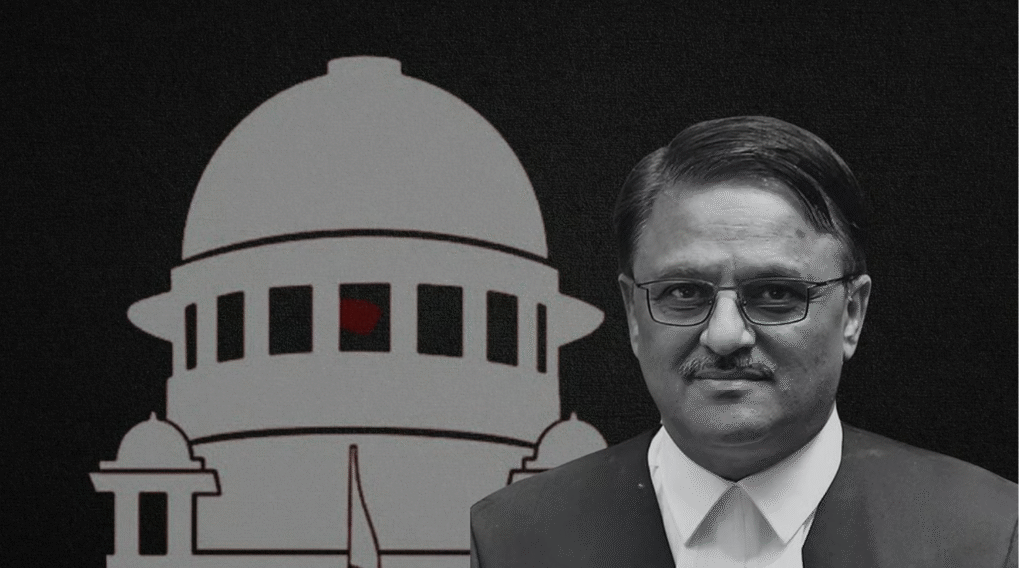
Recently larger bench of the supreme Court set aside the judgment passed by Justice Abhay Oka which was passed him against the binding precedent of the Supreme Court. [Confederation of Real Estate Developers of India v. Vanashakti, 2025 SCC OnLine SC 2474]
New Delhi: The Junior Advocates and Law Students Association of India (JALSAI) on Tuesday announced a boycott of retired Justice Abhay Oka, asserting that its decision is based on what it describes as a consistent pattern of judicial conduct during his tenure which, according to the Association, threatened and undermined free, fearless, and fair advocacy, discouraged advocates and litigants from raising bona fide grievances, and diluted established safeguards against corruption and dishonesty in court proceedings. While Justice Abhay Oka was serving as a judge, certain judicial orders had the effect of curtailing free, fearless, and fair advocacy, shielding wrongdoing and discouraging transparency within the justice delivery system. The Association emphasized that these concerns are based on judicial records and binding precedents of larger benches which Justice Oka ignored conveniently to serve his purposes, and that its position is founded on legal analysis rather than personal criticism.
The Association has cited three major instances to demonstrate the complete lack of bona fides on the part of Shri Abhay Oka, characterising his conduct as patently hypocritical—preaching ethical standards to others while himself issuing orders that were manifestly counter-productive and wholly non-conducive to the independence of the Bar and to the delivery of fair, expeditious, and impartial justice, and which instead fostered and promoted dishonesty and corruption, thereby gravely undermining the interests of both the Bar and the Bench.
The following three major instances are relied upon by the Association to substantiate its allegations of conduct detrimental to the independence of the Bar and the administration of justice:
(i) Case concerning Advocates and Counsels raising grievances against the Judge, wherein contempt show cause notices were issued against them who were threatened with issuing contempt notice for making pleadings of their grievances against the judge. Such action was in direct contravention of binding Constitution Bench judgments which categorically prohibit the use of contempt jurisdiction to stifle legitimate criticism and grievances raised by members of the Bar.
(ii) Senior Social Activist Shri Anna Hazare’s case against Shri Sharad Pawar, wherein Justice Abhay Oka refused to order registration of an FIR and handover the case to CBI and passed orders contrary to settled law and binding precedents, with the effect of discouraging citizens and social activists from exposing large-scale corruption involving public funds running into thousands of crores, thereby undermining public interest litigation and constitutional accountability.
(iii) A case involving submission of a false affidavit by the wife to harass the husband, wherein, despite clear statutory mandates and binding precedents requiring prompt initiation of perjury proceedings, Justice Abhay Oka failed to take immediate action and instead passed orders that effectively emboldened dishonest litigants to commit perjury, file false affidavits, and deliberately prolong judicial proceedings.
In a detailed statement placed on record, the Association alleged that certain judicial orders attributed to Justice Oka had the effect of silencing legitimate criticism, deterring truthful pleadings through the threat of contempt action, and weakening the law relating to perjury, thereby enabling misuse of the judicial process by dishonest litigants. The Association emphasized that its position is founded on judicial records and binding precedents of the Supreme Court, and that the boycott is an institutional and symbolic measure aimed at highlighting concerns relating to judicial accountability, protection of constitutional advocacy, and the integrity of the justice delivery system, particularly from the standpoint of common citizens and honest litigants.
Allegations Relating to unjustified Contempt Proceedings and attack on Free Advocacy to create fear in the mind of advocates.
One of the principal issues highlighted by the Association pertains to the judgment in Municipal Council, Tikamgarh v. Matsya Udyog Sahkari Samiti, 2022 SCC OnLine SC 1900, wherein contempt show-cause notices were issued to the advocates on record, senior counsel, and the petitioner. These notices were issued solely on the ground that the pleadings alleged misconduct on the part of a High Court Judge and without mentioning or verifying that whether said pleadings are true or false.
Law is very well settled that treating such pleadings as “scandalous,” even when supported by material on record, is contrary to binding precedents of the Supreme Court and settled constitutional and contempt jurisprudence. In support of this contention, reliance has been placed on a long line of authoritative precedents, including:
- Indirect Tax Practitioners’ Association v. R.K. Jain, (2011) 8 SCC 281
- Subramanian Swamy v. Arun Shourie, (2014) 12 SCC 344 (Constitution Bench)
- Bathina Ramakrishna Reddy v. State of Madras, 1952 SCR 425 (Constitution Bench)
- In re: C.S. Karnan, (2017) 7 SCC 1 (affirming Lalit Kalita, In re, (2008) 1 Gau LT 800)
- S.R. Ramraj v. Special Court, Bombay, (2003) 7 SCC 175
- Nirbhay Singh Suliya v. State of Madhya Pradesh, (2026 INSC 7)
- Suo Motu v. Mahavir Sampatrai Parmar, 2015 SCC OnLine Guj 6300
- Craig v. Harney, 1947 (US Supreme Court, Nine-Judge Bench)
According to these precedents, truthful pleadings supported by substantial material, and raised for seeking legal redress do not amount to contempt, and courts are duty-bound to first determine the falsity of such allegations before initiating contempt proceedings.
The Constitution Benches categorically held that the publication of truthful facts exposing judicial misconduct, is in public interest, and it does not constitute contempt of court only publication of falsehood has the said effect.
In a recent judgment in the case of Nirbhay Singh Suliya v. State of Madhya Pradesh (2026 INSC 7), Hon’ble supreme Court made it clear that if allegations against a Judge are found to be true, disciplinary as well as criminal proceedings may be directed against the concerned Judge, and that only when such allegations are found to be false, frivolous, or mala fide can action be taken against the complainant or the advocates under the law of contempt.
The Association has additionally pointed out the binding precedents which rules that advocates, as officers of the court, are entitled to dignity, independence, and adequate latitude to discharge their professional duties fearlessly. It has stated that any judicial action perceived as intimidating advocates through threats of contempt can have a chilling effect on constitutional advocacy, and that threatening an advocate for performing his professional duty itself amounts to an abuse of contempt jurisdiction making such Judicial officer liable for action under contempt. In fact, any attempt by the judge to threaten advocates to deter him from performing his duty makes such Judge liable for action and punishment under Section 166, 218, 219, etc of IPC,1860 and Section 2(c),12,16 of the contempt of Courts Act,1971.
An advocate is not required to be servile, and where there exist reasonable and substantial grounds for a serious complaint against a judicial officer, it is both the right and the duty of the advocate to place such grievances before appropriate authorities. The Supreme Court in many binding judgments has cautioned that reducing the Bar to a state of fear, sycophancy, or subservience is impermissible and destructive of the fair administration of justice. In support of these submissions, reliance has been placed on decisions including Latief Ahmad Rather v. Shafeeqa Bhat, 2022 SCC OnLine J&K 249; Ghanshyam Upadhyay v. State of Maharashtra, 2017 SCC OnLine Bom 9984; Arnab Ranjan Goswami v. Maharashtra State Legislative Assembly, 2020 SCC OnLine SC 1100; H. Syama Sundara Rao v. Union of India, 2006 SCC OnLine Del 1392; Jai Chaitanya Dasa, 2015 SCC OnLine Kar 549; and Court on Its Own Motion v. DSP Jayant Kashmiri, 2017 SCC OnLine Del 7387, Harish Chandra Mishra v. Hon’ble Mr. Justice S. Ali Ahmed, 1985 SCC OnLine Pat 213; R. Muthukrishnan v. High Court of Madras, (2019) 16 SCC 407; Chetak Construction Ltd. v. Om Prakash, (1998) 4 SCC 577, Muhammad Shafi v. Choudhary Qadir Bakhsh, 1949 SCC OnLine Lah 14, Neeraj Garg v. Sarita Rani, (2021) 9 SCC 92, Dushyant Mainali v. Diwan Singh Bora, 2024 SCC OnLine SC 5178.
CASE RELATING TO SOCIAL ACTIVIST SHRI ANNA HAZARE
A significant instance cited in support of its stand relates to a writ petition filed by senior social activist Shri Anna Hazare, wherein large-scale corruption involving thousands of crores of rupees was alleged and a prayer was made for registration of an FIR (Writ Petition No. 46 of 2016).
When the matter came up before a Bench presided over by Justice Abhay Oka, the established legal position, as laid down by the Supreme Court in Noida Entrepreneurs Association v. Noida, (2011) 6 SCC 508, and followed in several subsequent cases, required that such a writ petition alleging cognizable offences be treated as an FIR and investigated by an appropriate agency, including the CBI, where circumstances so warranted.
However, by an order dated 06.01.2017, the Court instead directed Shri Anna Hazare to first approach the police authorities and only thereafter seek recourse before the High Court. The Association has alleged that this approach was contrary to binding precedent and departed from the established procedure evolved by the Supreme Court for addressing serious allegations of corruption raised through public interest litigation.
Such an order had the effect of discouraging social activists and whistle-blowers, and, in its view, undermined public confidence in the justice delivery system, particularly from the perspective of ordinary citizens seeking accountability in cases of high-level corruption.
Passing Orders That Promote Perjury and Enable Dishonest Litigants to Delay Justice
The Association has raised serious objections to the judicial reasoning attributed to Justice Abhay Oka in cases involving alleged false affidavits, particularly in Dr. Santosh Chandrashekar Shetty v. Ameeta Santosh Shetty, 2019 SCC OnLine Bom 99. The view expressed therein—that applications for perjury should ordinarily be deferred until the conclusion of the main proceedings, and that even upon a prima facie finding of perjury it is not necessary to take immediate action—runs contrary to settled law and substantially weakens the deterrent purpose of perjury statutes.
By declining to issue effective directions or guidelines for curbing perjury and by avoiding prompt action against dishonest litigants—unlike the approach consistently adopted by several High Courts and the Supreme Court—the said reasoning has the effect of diluting the law on perjury and emboldening litigants to abuse the judicial process with impunity.
The law on this issue stands firmly settled by multiple authoritative judgments of the Supreme Court, which mandate immediate and stern action against dishonest litigants. The Supreme Court has repeatedly held that where the very foundation of a claim is found to be false, such litigants are not entitled to be heard on merits. Reference in this regard may be made to Kishore Samrite v. State of U.P., (2013) 2 SCC 398; K.D. Sharma v. SAIL, (2008) 12 SCC 481; and H.S. Bedi v. National Highway Authority of India, 2016 SCC OnLine Del 432, New Delhi Municipal Council v. Prominent Hotels, 2015 SCC OnLine Del 11910; Perumal v. Janaki (2014) SCC (Cri) 591.
A Constitution Bench of this Court in Iqbal Singh Marwah v. Meenakshi Marwah, (2005) 4 SCC 370, has, in paragraph 32—while relying upon an earlier Constitution Bench decision—categorically ruled that criminal proceedings relating to perjury must be initiated and conducted expeditiously, accorded precedence over the main proceedings, and that, until such perjury proceedings are concluded, even the underlying civil proceedings may be stayed. Similar is the view in the cases of Gulab Chaturkar vs Vimalbai 2022 SCC OnLine Bom 11964, Praveen R. v. Arpitha, 2021 SCC OnLine Kar 15703.
However, in Dr. Santosh Chandrashekar Shetty v. Ameeta Santosh Shetty, Justice Oka departed from this well-settled principle by holding that perjury applications should be decided only at the end of the proceedings. Such an approach effectively permits dishonest litigants, often over several years, to continue abusing the judicial process, harassing honest litigants, and burdening the courts—thereby defeating the very object of fair, expeditious, and impartial justice.
The said view was per incuriam even at the time it was rendered and, in any event, now stands impliedly overruled by subsequent authoritative pronouncements of the Supreme Court.
In Sarvepalli Radhakrishnan University v. Union of India, (2019) 14 SCC 761, a larger Bench of the Supreme Court first called for a report on perjury, adjudicated the matter on that basis, and directed prosecution against the dishonest litigant—thereby reaffirming the principle of prompt and effective action.
Further, the subsequent judgments of the Supreme Court in ABCD v. Union of India, (2020) 2 SCC 52, and Sundar v. State, 2023 SCC OnLine SC 310, have conclusively rejected the deferment approach. In Sundar v. State, the larger Bench of the Supreme Court categorically held that a court would be failing in its duty if prompt action is not taken against dishonest litigants and expressly observed that earlier contrary views stand impliedly overruled.
Accordingly, the reasoning adopted in Dr. Santosh Chandrashekar Shetty v. Ameeta Santosh Shetty not only runs contrary to binding precedent but also actively undermines the administration of justice by promoting perjury, shielding dishonest litigants, and facilitating prolonged abuse of the judicial process.