Crackdown on False Cases: No Leniency for Guilty Litigants, Lawyers, or Erring Police and Judicial Officials. High Court issued guidelines. [Umme Farva v. State of U.P. and Another (2026: AHC: 8949)]
No Bail for Such Dishonest Persons or Officers. Supreme Court [Naveen Singh v. State of U.P., (2021) 6 SCC 191]
In a strong warning aimed at curbing the growing menace of false and fabricated litigation, the Supreme Court and various High Courts have made it clear that strict criminal action, without any compromise, is mandatory against those involved in filing fraudulent cases.
The directions apply not only to litigants who institute false, fabricated, or malicious proceedings, but also to their masterminds, lawyers who directly or indirectly aid such abuse of the legal process, and individuals involved in conspiracies to manufacture false cases. Importantly, the courts have also held that police officers and judicial officers who fail to act even after the falsehood is exposed will equally face criminal, contempt, and disciplinary action.
Courts have emphasised that filing false cases, producing fabricated evidence, making false statements on oath, or suppressing material facts amounts to a serious abuse of the justice delivery system, warranting prosecution, contempt of court proceedings, and departmental action, wherever applicable.
Against this backdrop, the Indian Bar Association has announced that it will soon organise training programmes to educate citizens and members of the Bar on the legal consequences of false cases, false affidavits, and misuse of judicial processes. Sharing this information, the Association’s National President, Adv. Nilesh Ojha, said the initiative aims to promote legal awareness, discourage misuse of courts, and strengthen the integrity of the justice system.
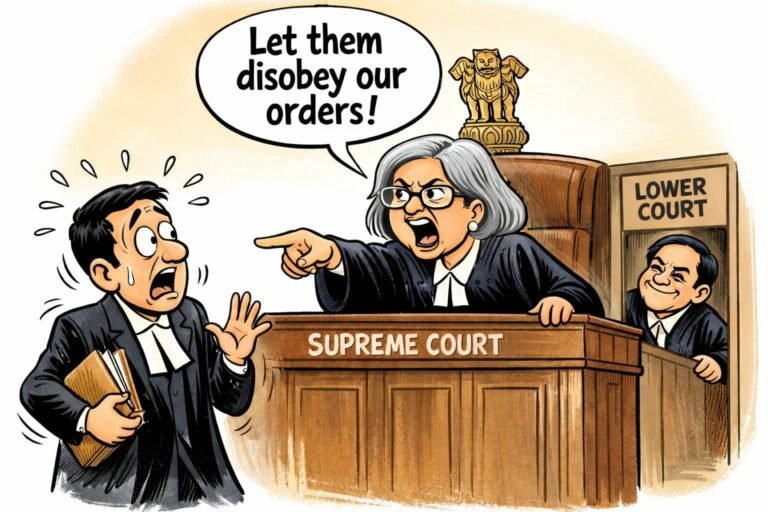
The Supreme Court and various High Courts have issued a clear and stern warning that no leniency will now be shown to lawyers and litigants who file false criminal cases and misuse the judicial and police machinery, as well as to police officers and judges who deliberately avoid taking action in such cases.
The courts have categorically held that filing false cases, fabricating evidence, submitting false information on affidavit, or suppressing material documents are serious criminal offences, and that criminal prosecution in such matters is mandatory.
Reiterating this position, the Supreme Court of India and several High Courts across the country have made it clear that lawyers, litigants, masterminds, and conspirators who deliberately abuse the judicial and police system by instituting false, fabricated, and malicious criminal cases—along with police and judicial officers who intentionally refrain from taking action in such matters—will not be granted any exemption, protection, or pardon.
In this context, the High Court has recently issued significant directions in the case of Umme Farva v. State of U.P. and Another (2026: AHC: 8949).
The courts have emphatically observed that filing false cases, creating fabricated or false evidence, making untrue statements on oath, suppressing vital documents, or making misleading statements before the court are not mere procedural lapses but grave offences. Such acts do not only cause injustice to an individual litigant, but also undermine the sanctity, credibility, and integrity of the entire justice delivery system, and erode public confidence in the rule of law. Therefore, criminal action in such cases is compulsory, and any neglect, inaction, or compromise is impermissible, the courts have underlined.
Importantly, the courts have also directed that if, even after the falsehood is exposed, the concerned police officers or judges deliberately fail to take action, they must be proceeded against for contempt of court as well as subjected to strict disciplinary proceedings. The objective behind these directions is to put an end to the misuse of the judicial process and to break the chain of protection afforded to wrongdoers.
By consolidating these important judicial directions, the Indian Bar Association has prepared and published a series of articles, guidebooks, and research-based publications explaining how to lodge complaints against false cases, how to pursue a lawful legal battle, the remedies available under law, and the manner in which justice can be secured through legal means.
Continuing this initiative, and with the objective of providing ordinary citizens as well as members of the legal profession with detailed, practical, and guidance-oriented information on the relevant laws, the Indian Bar Association will organise training camps at both the State and National levels, informed the Association’s National President, Adv. Nilesh Ojha.
In furtherance of public interest and national service, approximately 500 volunteer advocates have formally registered with the Indian Bar Association to support this nationwide outreach. These volunteers will conduct training camps, legal workshops, public interaction programmes, and guidance sessions at the State and District levels, aimed at creating legal awareness among citizens, students, and advocates.
For the effective execution of this large-scale campaign, a National Coordination Committee has been constituted, with Adv. Iswarlal Agarwal serving as its Chairperson. Under his leadership, the campaign’s planning, implementation, and nationwide coordination will be undertaken. The initiative has also received formal support from several reputed national organisations, including the Junior Advocates and Law Students Association of India, the Indian Lawyers and Human Rights Activists Association, and the Supreme Court and High Court Litigants Association.
With the collective participation of these organisations, the campaign is expected to assume a truly nationwide character. The organisers have clarified that the core objective of this initiative is to promote practical, accessible, and effective public awareness regarding law, justice, and the rights and duties of citizens, while strengthening public confidence in the justice delivery system.
During these training programmes, in-depth and practical guidance will be provided on the proper use of law, the serious consequences of misuse of legal processes, the social and personal harm caused by false cases, the rights and responsibilities of citizens, and the professional, ethical, and constitutional role of lawyers. The initiative is aimed at enhancing public awareness of the justice system, curbing the menace of false litigation, and preserving the credibility and integrity of judicial institutions.
If Action Is Avoided, Police Officers and Judges Also Become Liable
In accordance with judicial directions, it is mandatory for the concerned police officers and judicial officers to initiate action against guilty litigants who file false cases as well as lawyers who assist or abet such conduct, under Sections 211, 177, 182, 191, 192, 193, 199, 200, and 220 of the Indian Penal Code (IPC), and under the relevant provisions of the new Bharatiya Nyaya Sanhita (BNS), including Sections 248, 212, 217, 227, 228, 229, 236, and 237.
Failure to take such action will amount to grave dereliction of duty and will be treated as deliberate avoidance intended to shield the accused, as well as indirect encouragement of criminal activity. Consequently, the concerned officials and judges may themselves be prosecuted under IPC Sections 166, 201, 218, 219, 220, 107, 34, 120B, 192, 193, 409, among others. In addition, stringent action under the Contempt of Courts Act, 1971, particularly Sections 2(b) and 12, as well as departmental disciplinary proceedings (including suspension and dismissal) have been clearly directed.
Licences of Guilty Lawyers to Be Cancelled
Courts have also directed that disciplinary action be taken against lawyers involved in fabricating false cases or supporting such conduct, including cancellation of their licence to practice law. Judicial observations further note that such lawyers have also been awarded sentences of imprisonment.
Scope of Offence Under IPC Section 218
For an offence punishable under IPC Section 218, the actual guilt or innocence of the person sought to be saved from punishment is irrelevant. It is sufficient that information regarding a cognizable offence has been officially brought to the notice of the concerned accused, and that, with the intention of shielding the offender from punishment, the accused police officer or public servant has deliberately prepared false entries, records, or reports.
No Bail for Such Dishonest Persons or Officers
The Supreme Court of India has made it unequivocally clear that persons who deliberately produce false evidence, file false affidavits, or otherwise misuse the judicial process cannot claim bail as a matter of right. The Court has emphasised that such accused should be tried while being kept in judicial custody, and that neither anticipatory bail nor regular bail should ordinarily be granted in cases involving calculated falsehood and abuse of the justice system.
The rationale behind this strict approach is to protect the sanctity and credibility of judicial proceedings and to ensure that no wrong or misleading message is conveyed to society. Grant of bail to such offenders, the Court has cautioned, legitimises dishonesty, emboldens abuse of process, and erodes public confidence in the rule of law.
Encouraging Falsehood Is a Social Crime
Failire by the Judge to take action against those who submit false evidence amounts to allowing criminals to roam free and creating social pollution. The Supreme Court and various High Courts have taken a firm legal stand that no permission or tolerance can be shown for such conduct.
Avoidance of Action in Practice
However, in reality, it has often been observed that police officers, public prosecutors, and even some judges avoid taking action against guilty litigants and their lawyers. In certain cases, illegal orders stating that “no action is required” have also been passed. The legal provisions for initiating criminal prosecution, contempt of court proceedings, and disciplinary action against such officers and judges have been clearly laid down through multiple judicial pronouncements.
Rejecting Truth Is a Grave Offence
The courts have unequivocally held that encouraging falsehood and rejecting the truth constitutes a very serious offence, which is not merely an individual wrong but an assault on the entire justice delivery system. Consequently, the courts have issued a clear and unequivocal message that no one will be granted protection in such cases.
For more details, please visit the website of the Indian Bar Association.
The selected and important judgments of the Supreme Court mentioned above are as follows.
I. Umme Farva vs. State of U.P. and Another 2026: AHC:8949
II. ABCD v. Union of India, (2020) 2 SCC 52
III. Sundar v. State, 2023 SCC OnLine SC 310
IV. State of Maharashtra v. Mangesh, 2020 SCC OnLine Bom 672
V. Perumal v. Janaki, (2014) 5 SCC 377
VI. Nirbhay Singh Suliya v. State of M.P., 2026 SCC OnLine SC 8
VII. State of Gujarat v. Kishanbhai, (2014) 5 SCC 108
VIII. Kusha Duruka v. State of Odisha, (2024) 4 SCC 432
IX. Kodali Purnachandra Rao v. Public Prosecutor, (1975) 2 SCC 570
X. Moti Ram v. Emperor, AIR 1925 Lah 461.
XI. Tata Mohan Rao v. S. Venkateswarlu, 2025 SCC OnLine SC 1105
XII. Harish Arora v. Registrar of Coop. Societies, 2025 SCC OnLine Bom 2833
XIII. Priya Gupta v. Ministry of Health & Family Welfare, (2013) 11 SCC 404
XIV. New Delhi Municipal Council v. Prominent Hotels Limited, 2015 SCC OnLine Del 11910
XV. Mohd. Nazer M.P. v. State (UT of Lakshadweep), 2022 SCC OnLine Ker 7434
XVI. Manu Sharma v. State (NCT of Delhi), (2010) 6 SCC 1
XVII. State of Maharashtra Vs. Kamlakar Bhavsar 2002 ALL MR (Cri) 2640
XVIII. K. Ram Reddy v. State of A.P., 1997 SCC OnLine AP 1210
XIX. Re M.P. Dwivedi, (1996) 4 SCC 152
XX. Garware Polyester Ltd. v. State of Maharashtra, 2010 SCC OnLine Bom 2223
XXI. Prabha Sharma v. Sunil Goyal, (2017) 11 SCC 77
XXII. R.R. Parekh v. High Court of Gujarat, (2016) 14 SCC 1
XXIII. Muzaffar Husain v. State of U.P., 2022 SCC OnLine SC 567
XXIV. Shrirang Yadavrao Waghmare v. State of Maharashtra, (2019) 9 SCC 144
XXV. State of Odisha v. Pratima Mohanty, 2021 SCC OnLine SC 1222
XXVI. Raman Lal v. State of Rajasthan, 2000 SCC OnLine Raj 226
XXVII. Dr. Praveen R. Vs. Dr. Arpitha 2021 SCC OnLine Kar 15703
XXVIII. H.S. Bedi v. National Highway Authority of India, 2016 SCC OnLine Del 432
XXIX. A Vakil, In re, 1926 SCC OnLine All 365
XXX. Ashok Kumar Sarogi Vs. State of Maharashtra 2016ALLMR (Cri) 3400
XXXI. Naveen Singh v. State of U.P., (2021) 6 SCC 191;
XXXII. Sushil Ansal v. State (NCT of Delhi), 2022 SCC OnLine Del 482;
XXXIII. Dilip v. State of Gujarat, 2011 SCC OnLine Guj 7522, Arvindervir Singh v. State of Punjab, (1998) 6 SCC 352;
XXXIV. Samson Arthur v. Quinn Logistic India Pvt. Ltd., 2015 SCC OnLine Hyd 403
XXXV. Arun Dhawan v. Lokesh Dhawan, 2014 SCC OnLine Del 6886
XXXVI. Ranbir Singh Vs. State 1990 SCC OnLine Del 40
XXXVII. Silloo Danjishaw Mistri v. State of Maharashtra, 2016 SCC OnLine Bom 3180.