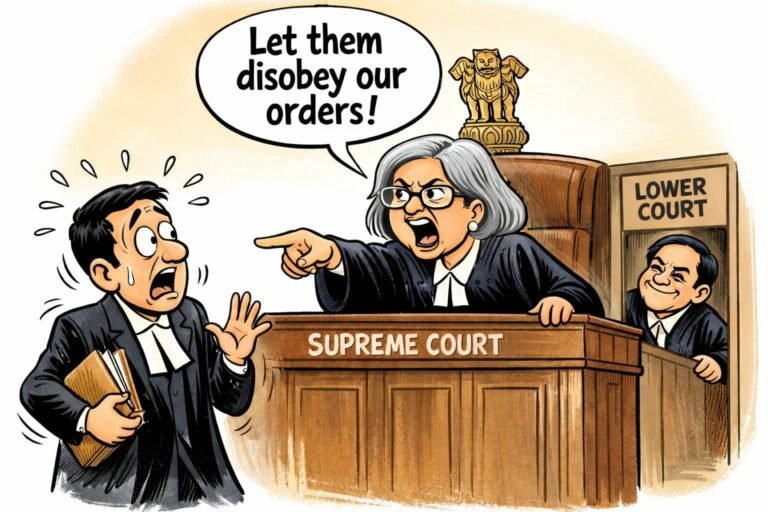
Corrupt Judges Are Anti-National; a Threat to the Nation’s Progress . Judicial Corruption: The Greatest Enemy of the Constitution. — Stern Warning from the High Court.
The High Court’s message is clear — corruption is the biggest obstacle to national development. When justice is sold, the nation’s progress comes to a halt. Therefore, firm and decisive action against corruption is the only true path in the national interest, the Court has categorically emphasized.
[R. Rajaraman v. The Chief Engineer (Personnel), 2019 SCC OnLine Mad 4661]
Several landmark judgments of the Hon’ble Supreme Court of India and various High Courts in the case of Indirect Tax Practitioners’ Assn. v. R.K. Jain, (2010) 8 SCC 281 and in Bathina Ramakrishna Reddy AIR 1952 SC 149 , Subramanyam Swamy (2014) 12 SCC 344, Aniruddha Bahal 2010 (119) DRJ 102, have unequivocally recognized that, in the larger public interest, corruption in the judiciary must be brought to light, including through investigative means such as sting operations. These judgments hold that such exposure is not only permissible but flows from the fundamental duty of every citizen under Article 51A of the Constitution.
It affirms that every Indian citizen has a fundamental and constitutional right to an honest, independent, and incorruptible judiciary and executive, a right that flows from Articles 14, 19, and 21 of the Constitution. Consequently, citizens have not merely a moral right, but a constitutional duty to take lawful steps to expose, oppose, and seek the removal and prosecution of corrupt and dishonest judges and public officials. Any such effort, undertaken within the bounds of law to expose corruption, demand accountability, and restore institutional integrity, is constitutionally protected and reinforced by binding judicial precedent.
In one of its strongest and most forthright observations to date on corruption in public life—particularly within the judiciary—the Madras High Court has categorically stated that corrupt judicial officers and public servants who obstruct the nation’s development should be declared “anti-national.” The Court’s remarks are being viewed as a serious warning bell for the entire system.
In its landmark judgment in R. Rajaraman v. The Chief Engineer (Personnel), 2018 SCC OnLine Mad, the High Court observed that corruption in India is no longer confined to isolated criminal acts but has become a “way of life,” tormenting the common citizen from birth to death. The Court noted that this grim reality has shaken the very foundations of constitutional governance and has severely eroded public faith in democratic institutions.
The Court underlined that corruption has infiltrated almost every sphere—healthcare, education, employment, government welfare schemes, and the justice delivery process itself. It issued a specific and serious warning that corruption within the judiciary is particularly grave, as it endangers the credibility of the entire system and strikes at the heart of the rule of law.
Against this backdrop, the Indian Bar Association’s long-running campaign for judicial accountability and anti-corruption awareness has gained renewed momentum. The campaign, active for several years, closely aligns with growing public concerns regarding transparency, accountability, and institutional integrity within the judiciary and other governmental institutions.
As a result of this sustained initiative, public awareness has increased substantially, and demands for concrete, step-by-step measures to curb corruption are growing stronger. Legal experts believe that the unequivocal observations of the High Court, the strict legal framework laid down by the Hon’ble Supreme Court and various High Courts, together with the active, organized, and vigilant role of Bar Associations, can collectively provide a decisive impetus for meaningful and long-overdue systemic reforms.
The High Court’s message is unambiguous: When justice is put up for sale, the nation’s progress comes to a halt. Therefore, firm and decisive action against corruption is not merely desirable but is the only true path in the national interest, the Court has emphatically underscored.
Corruption: The Biggest Obstacle to National Development
The Court lamented that despite India having “beautiful statutes and constitutional ideals,” corruption in public administration has crippled governance, destroyed public trust, and denied citizens their fundamental rights under Article 21 of the Constitution. It noted that citizens are compelled to pay bribes even for basic necessities such as healthcare, education, employment, burial of the dead, and welfare benefits.
The judgment emphasized that corruption is not merely a moral failure but a direct attack on constitutional mandates, equality, and democratic institutions.
Judiciary Not Exempt — A Stark Judicial Admission
In an unprecedented and candid acknowledgment, the High Court held that the judiciary itself is not immune from corruption. The Court recorded that litigants are often forced to pay bribes during the judicial process, including at court registries and legal departments, and that such corruption is increasing rather than diminishing.
Most significantly, the Court made the following categorical observation:
“Corrupt Judicial Officers are to be declared as Anti-Nationals… They are anti-nationals because they are obstructing the developmental activities of our Great Nation.”
The Court reasoned that just as terrorists are labelled anti-social elements for harming the nation, corrupt judges and officials who sabotage development and justice are equally destructive to national integrity.
Judicial Corruption: Enemy of the Constitution
The High Court described corruption in the judiciary as the greatest enemy of the Constitution, warning that if left unchecked, it would shake the very pillars of democracy. The judgment underscored that constitutional courts have a duty to protect honest officers and citizens and to ensure that the “minority non-corrupt” are not crushed by the “majority corrupt.”
Using a powerful civilizational metaphor, the Court observed that the battle against corruption is akin to Pandavas versus Kauravas, expressing hope that constitutional values would ultimately prevail.
Call for Structural Reform and Moral Reawakening
The judgment called upon the State to strengthen vigilance and anti-corruption mechanisms, including oversight over vigilance bodies themselves, noting with concern that corruption has even infiltrated anti-corruption departments.
It stressed that patriotism, constitutional morality, and integrity must be instilled from childhood, and that corruption is fundamentally anti-national because it sacrifices collective progress for selfish gain.
A Judicial Warning to the Nation
This landmark judgment stands as a rare and fearless judicial warning:
Corruption in the judiciary is not a private wrongdoing — it is a national crime.
When justice is sold, development stalls, democracy erodes, and the nation suffers.
The Court’s message is unequivocal: A corrupt judge is not merely a bad judge — he is an obstacle to the nation’s progress.
The Indian Bar Association has been consistently running a nationwide judicial accountability and public awareness campaign for the last more than three decades, aimed at strengthening the rule of law and safeguarding constitutional values. Under the leadership of its National President, Advocate Nilesh Ojha, and with the active cooperation and participation of members of the Association across the country, the campaign has taken a structured and sustained form.
As part of this initiative, Advocate Nilesh Ojha, along with his association colleagues, has systematically compiled authoritative legal precedents, judicial pronouncements, and constitutional principles, and has published books, scholarly articles, and research material addressing the issue of judicial corruption and accountability. The campaign has also been carried forward through public lectures, seminars, video commentaries, podcasts, interviews, and legal awareness programs, aimed at educating citizens, lawyers, and young members of the Bar about their constitutional rights and duties.
In furtherance of this mission, the Association and its leadership have filed multiple writ petitions, complaints, and legal proceedings before constitutional courts and other competent authorities, seeking lawful action against corrupt and dishonest judges, while simultaneously advocating for the protection of honest and upright members of the judiciary.
In recent times, this long-standing campaign has gained significant momentum, resonating strongly with prevailing public concerns regarding transparency, accountability, and integrity in institutions. The movement is now receiving growing support from all sections of society, including senior advocates, young lawyers, academics, civil society groups, whistleblowers, and concerned citizens, as well as wide sections of the legal fraternity across the country.
The Indian Bar Association asserts that this campaign is firmly rooted in the constitutional mandate to strengthen judicial credibility, protect honest judges, and uphold public confidence in the justice delivery system, thereby reinforcing the institutional integrity of courts and serving the larger national interest.