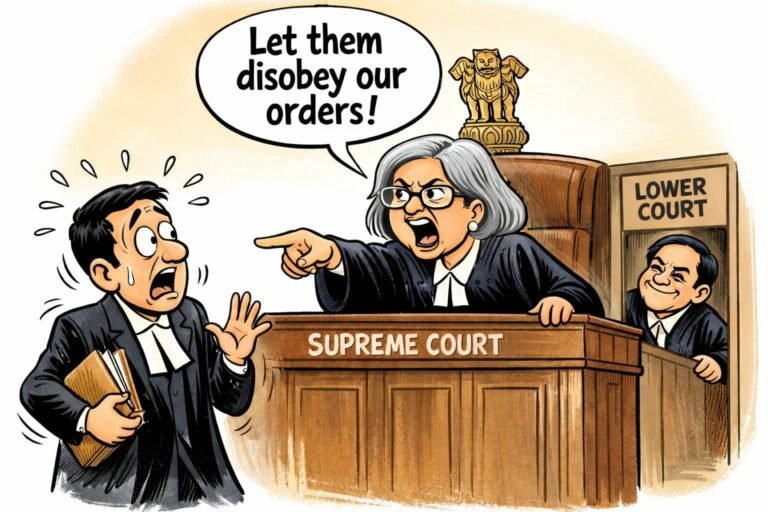
After Supreme Court SOP, Indian Bar Association Welcomes Move; Issues Advisory to Advocates on Written Submissions
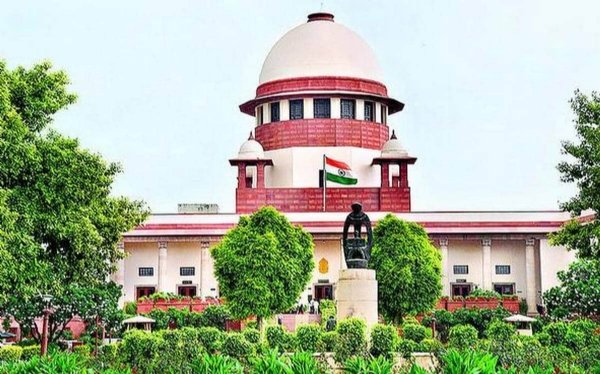
Welcoming the Supreme Court’s Standard Operating Procedure (SOP) on written submissions and timelines for arguments, the Indian Bar Association (IBA), along with the Junior Advocates and Law Students Association, has hailed Hon’ble Chief Justice of India Justice Surya Kant’s historic and reform-oriented steps as being in the larger interest of citizens, judicial institutions, the common litigant, and young members of the Bar.
The associations have described the SOP as a decisive move towards discipline, efficiency, transparency, and equal opportunity, particularly benefiting junior advocates and litigants who cannot afford prolonged or unstructured hearings.
Simultaneously, the IBA has issued a nationwide advisory to advocates, cautioning that misleading the Court, suppression or distortion of facts, selective citation of law, or non-disclosure of binding precedents will attract serious legal consequences, including contempt of court, disciplinary proceedings, prosecution under the IPC and Bharatiya Nyaya Sanhita (BNS), imposition of costs, and suspension or debarment from practice.
Advocates have been urged to exercise strict verification of facts and law, complete disclosure, professional candour, and intellectual discipline while filing written submissions, in keeping with their role as officers of the Court and partners in the administration of justice.
The Supreme Court Lawyers’ Association has reminded its members of various past instances where senior advocates have faced serious institutional scrutiny, including disciplinary proceedings, contempt actions, or complaints before statutory Bar Councils, arising out of allegations of misleading the Court, suppression of material facts, or conduct alleged to be inconsistent with the standards expected of officers of the Supreme Court.
In this context, reference has been made to publicly reported proceedings and complaints, including those concerning Sr. Adv. Siddharth Luthra, where issues relating to alleged professional misconduct and allegations of fraud upon the Supreme Court have been raised before competent forums and disciplinary authorities, and which remain matters of record, adjudication, or public legal debate.
Mumbai | New Delhi: Following the Supreme Court’s issuance of mandatory guidelines and a Standard Operating Procedure (SOP) to improve court management and ensure fairness in hearings, the Indian Bar Association (IBA) has issued a nationwide advisory to advocates, urging strict compliance while filing written submissions and addressing oral arguments.
Welcoming the Supreme Court’s SOP on timelines and written submissions, the IBA cautioned that written arguments are not a mere formality, but a serious professional responsibility governed by binding law. Advocates have been advised to maintain discipline, candour, verification of facts and law, and full disclosure, and to avoid any suppression, distortion, or misleading presentation—even if adverse to their client—to prevent contempt, disciplinary action, imposition of costs or prosecution.
Emphasising that written submissions are not a ritualistic formality but a solemn aid to justice, the Bar body has called upon advocates to exercise precaution, intellectual discipline, and complete candour. Lawyers have been advised to independently verify facts and legal positions, disclose all relevant precedents—even those adverse to their client, and refrain from advancing overruled or untenable submissions.
The IBA reiterated that advocates are officers of the court and equal partners in the administration of justice, and cannot act as mere mouthpieces of clients. Any attempt to obtain judicial orders by non-disclosure, misrepresentation, or manipulation of law or record, the advisory cautions, amounts to fraud upon the court and undermines the justice delivery system.
The advisory aligns with binding judicial precedents and seeks to ensure that the Supreme Court’s SOP achieves its stated objective of efficient court management, fair hearings, and timely justice, while preserving the integrity and credibility of the legal profession.
The advisory comes soon after a circular issued under the directions of Hon’ble CJI Surya Kant, prescribing fixed timelines for oral arguments, mandatory filing of concise written notes, and advance disclosure of submissions through the Supreme Court’s online portal. The move, the Court said, is aimed at effective court management and equitable distribution of working hours among benches.
Supreme Court’s New SOP: What Changes
As per the circular dated December 29, all counsel—Senior Advocates, arguing counsel and Advocates-on-Record—must:
• Submit timelines for oral arguments at least one day before the hearing;
• File brief written submissions (maximum 5 pages) after serving the opposite side, three days prior to hearing;
• Strictly adhere to time limits fixed by the Court and conclude arguments accordingly.
The Supreme Court has made it clear that written submissions are not a formality, but a critical aid to adjudication.
IBA: Written Arguments Must Assist, Not Mislead
Citing binding precedents including Kiran Chhabra & Anr. v. Pawan Kumar Jain (Delhi High Court), Kusha Duruka v. State of Odisha (2024), Lal Bahadur Gautam v. State of U.P. and E.S. Reddi v. Chief Secretary, Government of A.P., the IBA has warned that mechanical compilations, selective citations, or suppression of law may attract serious consequences.
According to the advisory, even within page limits, advocates are duty-bound to:
• Concisely present admitted and disputed facts;
• Clearly frame issues/propositions for determination;
• State applicable statutory provisions;
• Disclose all binding precedents, including those against their own case;
• Clearly articulate the ratio decidendi of relied judgments;
• Provide accurate citations and paragraph references for immediate verification.
“The page limit enhances—rather than dilutes—the responsibility of advocates to exercise intellectual discipline, candour and professional integrity,” the IBA said.
Suppression of Law Equals Fraud on Court
The advisory reiterates that advocates—especially government law officers and public prosecutors—carry a higher duty of fairness.
Any withholding or selective non-disclosure of:
• binding precedents,
• statutory provisions,
• material documents, or
• the status of judgments (overruled, stayed, or sub judice),
amounts to gross professional misconduct and, in appropriate cases, criminal contempt.
Advocates making submissions contrary to settled law without candid disclosure are deemed to be advancing overruled submissions, the IBA cautioned.
Verification of Instructions Is Mandatory
The Bar body has also underlined that lawyers cannot act as mere mouthpieces of clients. Advocates must:
• independently verify facts and instructions;
• refuse to rely on half-truths or doubtful material;
• avoid collusion in twisting facts or suppressing adverse record.
Where pleadings or affidavits are found to be false and the advocate’s complicity is evident, the IBA warned of prosecution, criminal contempt, and disciplinary action, including long-term suspension or removal from the rolls.
The relevant legal precedents, in which advocates were found guilty of serious professional and criminal misconduct, clearly demonstrate that courts have not hesitated to take stringent and exemplary action where the administration of justice was undermined. In these cases, advocates were saddled with heavy costs, prosecuted and arrested, denied bail, punished and sentenced, debarred from appearing before courts, suspended from legal practice for periods ranging from five years to permanent removal, and in appropriate cases, even stripped of the designation of Senior Advocate.
These judgments unequivocally establish that advocates who mislead courts, suppress material facts, distort law, fabricate pleadings, file false affidavits, or act in conscious collusion with litigants are not protected by professional privilege. On the contrary, such conduct has been consistently held to amount to fraud on the court, criminal contempt, and grave professional misconduct, attracting penal consequences under criminal law, along with disciplinary action under the Advocates Act and Bar Council Rules.
The precedents summarized below serve as a clear warning and binding reminder that the legal profession is a position of trust, not a license to deceive, and that zero tolerance applies where advocates compromise the purity, credibility, and integrity of the justice delivery system.
The Supreme Court Lawyers Association’s Chairman Adv. Ishwarlal Agarwal have urged their members to actively engage with scholarly and public-interest legal material hosted on the official platforms of the Indian Bar Association (IBA) and Supreme Court–related legal news portals, such as SC News including analytical blogs and commentaries that critically examine issues of professional ethics, courtroom conduct, and alleged departures from settled standards by members of the Bar. Members have been advised to read, study, and independently evaluate blogs and analytical articles that document, examine, and reference court records, judicial proceedings, pleadings, and other publicly available material concerning allegations of professional misconduct and ethical lapses attributed to certain senior members of the legal profession, including Adv. Siddharth Luthra, Adv. Darius Khambata, Adv. Sudeep Pasbola, Adv. Kapil Sibal, Adv. Abhishek Manu Singhvi, and others, as reflected in complaints seeking disciplinary action or matters currently under public and legal debate.
It has been seriously alleged that Sr. Adv. Siddharth Luthra, is guilty of playing fraud upon the court as while appearing before the Hon’ble Supreme Court in a bail matter, made a categorical false submission that co-accused persons had already been granted anticipatory bail, proving his malafides and grave concerns of the Court having been misled on a material fact. It has further been pointed out in complaints that Mr. Lurthra is habitual in playing fraud upon the Courts and he has placed reliance on overruled and per incuriam judgments, without candid disclosure of their precedential status, thereby compelling the Court to consider legal positions that were no longer good law. A larger Bench of the Hon’ble Supreme Court, headed by the then Chief Justice of India, expressly declined to continue Sr. Adv. Siddharth Luthra as Amicus Curiae, and he was removed from the case with disgrace. These events are now matters of record and are frequently cited to underscore the settled principle that misleading the Supreme Court—whether on facts or law—strikes at the very foundation of the justice delivery system, and that designation, seniority, or stature offers no immunity from institutional accountability. And the junior advocates mst not blindly rely upon such senor advocates.
It has been specifically clarified that such reading is intended purely for academic, ethical, and professional awareness, and that members must draw conclusions only on the basis of verified judicial records, pleadings, and outcomes. The initiative aims to sensitise young members of the Bar to the fact that professional stature, senior designation, or institutional influence does not place any advocate above the law, and that ethical accountability applies uniformly, irrespective of rank or reputation.
The Associations have emphasised that all material must be read critically, responsibly, and in the light of judicial records, and that conclusions must be drawn only on the basis of verified facts, court orders, and settled legal principles, reinforcing the core values of integrity, independence of the Bar, and respect for the administration of justice.
The following binding judicial precedents clearly establish that advocates who mislead courts, suppress material facts, fabricate pleadings, abuse judicial process, or act in conscious collusion with litigants have been subjected to severe penal, contempt, and disciplinary consequences, including prosecution, arrest, denial of bail, suspension, debarment, imposition of heavy cost and even loss of senior counsel designation:
i. Baduvan Kunhi v. K.M. Abdulla, 2016 SCC OnLine Ker 23602
ii. Ashok Kumar Sarogi Vs. State of Maharashtra 2016ALLMR (Cri) 3400
iii. A Vakil, In re, 1926 SCC OnLine All 365
iv. Silloo Danjishaw Mistri Vs State of Maharashtra and Others 2016 SCC OnLine Bom 11331.
v. R.K. Anand v. Delhi High Court, (2009) 8 SCC 106
vi. M. Veerabhadra Rao v. Tek Chand, 1984 Supp SCC 571,
vii. Silloo Danjishaw Mistri v. State of Maharashtra, 2016 SCC OnLine Bom 3180
viii. Ranbir Singh v. State, 1990 SCC OnLine Del 40
ix. H.S. Bedi v. National Highway Authority of India, 2016 SCC OnLine Del 43
x. Kusha Duruka v. State of Odisha, (2024) 4 SCC 432
xi. P.V.R.S. Manikumar v. Krishna Reddy, 1999 SCC OnLine Mad 107.
xii. Court on its own Motion vs R. K . ANAND 2009 CR L J 677
xiii. Yatin Oza v. High Court of Gujarat, (2021) SCC OnLine SC 1004
xiv. Three Judge Bench of the Supreme Court in R. K. Anand v. Registrar, Delhi High Court , 2009 AIR SCW 6876, had observed that the leniency shown by the High Court in meting out the punishment was quite misplaced and punishment given to him by the High Court was wholly inadequate and incommensurate to the seriousness of his actions and conduct. Supreme Court issued notice to Sr. Adv. R. K. Anand for enhancement of sentence and additionally show-cause why he should not be debarred from appearing in Courts for longer period.
CLEAR MESSAGE TO THE BAR
Legal experts observe that the combined effect of the Supreme Court’s Standard Operating Procedure and the Indian Bar Association’s advisory marks a decisive paradigm shift in courtroom advocacy—away from volume-driven, repetitive submissions and towards precision, accountability, transparency, and professional responsibility.
According to senior members of the Bar and court observers, the emphasis on concise written submissions, verified facts, accurate disclosure of binding law, and fixed timelines for arguments is intended to restore balance in courtrooms, protect the interests of ordinary litigants and junior advocates, and reinforce judicial discipline on both sides of the Bar.
Experts note that the reform signals a clear message: effective advocacy is no longer measured by length or theatrics, but by clarity, candour, and fidelity to law and record, with misleading submissions now carrying tangible institutional and legal consequences.
“The Court has set timelines; the Bar must now match them with integrity,” a senior practitioner remarked.
With courts tightening scrutiny on written submissions, the message is unambiguous: assist the court, don’t ambush it.